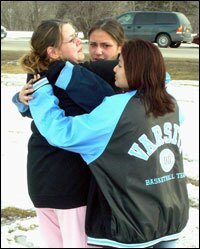
A teenage gunman who shot and killed five fellow students, a security guard, and a teacher in rural Minnesota was armed with three guns and multiple rounds of ammunition and was wearing a bullet-proof vest owned by his grandfather, a police officer, the Federal Bureau of Investigation said March 22.
At 2:55 p.m. on March 21, after first shooting and killing his grandfather and his grandfather’s companion, 16-year-old Jeff Weise drove to the front door of the 300-student Red Lake High School on the Red Lake Indian Reservation in his grandfather’s police vehicle, according to the FBI. A 28-year-old security guard confronted Mr. Weise, who then shot and killed the unarmed man. The teenager was armed with a .22-caliber handgun, a .40-caliber handgun, and a police shotgun, said Michael Tabman, the special agent who heads the FBI’s Minneapolis office.
Mr. Weise walked into the school, past a metal detector, and began shooting at a female teacher and a small group of students who were standing in a hallway, Mr. Tabman said. The teacher and students fled into a nearby classroom. Mr. Weise allegedly followed them and shot and killed the teacher and five students.
See the accompanying item,
Afterward, Mr. Weise roamed the school hallways, shooting “lots of rounds, [causing] lots of damage,” Mr. Tabman said at a televised news conference outside the school the day after the shootings. The teenager shot at least seven more people, five of whom remain in the hospital—some of them said to be in critical condition. Mr. Weise and four police officers who responded to calls for help from the school exchanged gunfire. At least one officer shot at the student, but Mr. Tabman said he was unsure whether the student was injured. Mr. Weise then returned to the classroom and shot himself in the head, according to the FBI agent. The entire incident took about 10 minutes.
Mr. Weise apparently acted alone and did not leave a message about his motive for any of the shootings, according to Mr. Tabman. He said a videotape shows Mr. Weise walking in the hallways of the school, but the agent declined to give more details. An FBI investigation is ongoing.
The incident was the second-deadliest school shooting in U.S. history. In April 1999, two student gunmen killed 12 other students, a teacher, and themselves at Columbine High School in Jefferson County, Colo.
Online Postings
Unofficial reports suggest that the teenager admired Adolf Hitler and had posted messages on a neo-Nazi Web site identifying himself as “todesengel,” or “angel of death” in German. The FBI declined to confirm that the student was involved in such activity. But the Libertarian National Socialist Green Party, a neo-Nazi group based in Austin, Texas, said in a report on its Web site that the student had posted 34 messages on the group’s online forum. The group blamed “society,” not Mr. Weise, for the deadly incident.
“Such events are to be expected when thinking people are crammed into an unthinking, irrational modern society,” said the bylined report on www.nazi.org. “The school shooting itself is not our failure; society is our failure, and the school shooting is a symptom.”
Courtesy of The Forum, Fargo-Grand Forks, N.D.

The teenager reportedly had a difficult personal history. His father committed suicide four years ago and his mother, debilitated by brain injuries, lives in a nursing home, according to press reports. Mr. Weise was taught at home in the school’s “Homebound” program for violating school policy, news reports said.
Despite its location on an Indian reservation, Red Lake High School is a traditional public school overseen by the state, rather than the federal Bureau of Indian Affairs. More than 90 percent of the roughly 540,000 American Indian students nationwide attend traditional public schools. They account for about 1 percent of the U.S. public school population and about 2 percent of the K-12 population in Minnesota.
Red Lake High School is not listed as having submitted a crisis-management policy to the Minnesota Department of Education, a standard piece of information the state collects from all schools. But Bill Walsh, a spokesman for the department, said all schools in the state, including Red Lake, had developed such policies. He added that early media reports describing the school’s response to the attack—such as its efforts to quickly “lock down” its campus—suggested that Red Lake had such a policy in place.
School crisis-response plans also require school officials to work with local communities to provide services to students in need of counseling, and Red Lake was likely to take that step this week, Mr. Walsh said. As of midday on Tuesday, March 22, state officials had been unsuccessful in their efforts to reach the district and offer services from state crisis-response experts, he said.
“A team is ready to help,” Mr. Walsh said.
Two years ago, a 15-year-old student at Rocori High School in Cold Spring, Minn., located about an hour west of Minneapolis, shot and killed two classmates. Some observers have said that the student accused of that crime may have been the victim of bullying. Since the Rocori incident, state officials have tried to encourage districts to take steps to curb bullying in schools, Mr. Walsh said.


