Teacher Preparation

Foundation To Study Preparation Of Teachers

By Julie Blair — March 21, 2001 3 min read
  • Save to favorites
  • Print

The Carnegie Foundation for the Advancement of Teaching unveiled a 5-year, $3- million initiative this month that will bring together some of the nation’s top scholars to examine how teacher education classes are taught, how prospective teachers learn, and how their learning is evaluated.

The initiative is one element of a 10-year, $10 million effort to study the ways in which professionals are trained, said Lee S. Shulman, the president of the nonprofit research organization, based in Menlo Park, Calif. The foundation began the project two years ago and is examining the professions of law, engineering, medicine, social work, and the clergy, in addition to teaching.
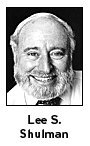
Leo S. Shulman

“This is the first time that the education of teachers has been examined systematically as part of a larger effort to understand the preparation for professions,” Mr. Shulman said. “In the preparation of lawyers and engineers, for example, there are some of the very same problems we thought were unique nightmares to education—they are universal.”

Because each profession uses different strategies to address similar problems, the foundation hopes to identify the best practices used in one vocation and apply them to others, he said.

The first task of the scholars investigating teacher preparation will be to look at the ways in which future K-12 educators are assessed, Mr. Shulman said. At least a dozen teacher-preparation programs will be examined, he added.

“Our challenge is to pull together the very best approaches developed and tried out in an attempt to assess how well teachers are learning their craft,” he said. “Then you can begin asking the other questions like ‘What are the most promising practices for teaching methods of teaching?’”

‘A Big Missing Piece’

Some education experts say that the project could generate information essential to improving teacher education and, as yet, unreported in a comprehensive manner anywhere else.

“The whole issue of documenting what it is that teachers should know and be able to do and how they’re taught these things is a big, big, big missing piece in policymaking,” said C. Emily Feistritzer, the president of the National Center for Education Information, a private research group based in Washington. “Without that data, it is very hard to make sound decisions about what should be done.”

Under its late president, Ernest L. Boyer, the Carnegie Foundation produced landmark studies on elementary education, high schools, school choice, colleges, and early childhood education.

The new initiative comes as several groups of researchers are posing similar questions about teacher preparation. “We’re going to take some responsibility for bringing them together and helping them sort out the information,” Mr. Shulman said. “We want this to be a collaborative effort.”

Among the researchers working on the project is Frank B. Murray, a professor of education and psychology at the University of Delaware in Newark and the president of the Teacher Education Accreditation Council, which accredits teacher-preparation programs in about 65 colleges and universities.

Other participants are: Pamela L.Grossman, a professor of education at Stanford University; Carol D. Lee, an associate professor of education at Northwestern University in Evanston, Ill.; Gary Sykes, a professor of education at Michigan State University in East Lansing; and Kenneth M.Zeichner, the assistant dean for the school of education at the University of Wisconsin-Madison. Carnegie Senior Scholar Rose Asera will co-direct the initiative along with Mr. Shulman.

The Carnegie Corporation of New York is financing the project.

A version of this article appeared in the March 21, 2001 edition of Education Week as Foundation To Study Preparation Of Teachers

Events

This content is provided by our sponsor. It is not written by and does not necessarily reflect the views of Education Week's editorial staff.
Sponsor
College & Workforce Readiness Webinar
The Road to Opportunity: Making CTE Accessible for All
The most valuable CTE happens off campus. For too many students, transportation is the barrier that keeps opportunity out of reach.
Content provided by HopSkipDrive
This content is provided by our sponsor. It is not written by and does not necessarily reflect the views of Education Week's editorial staff.
Sponsor
Recruitment & Retention Webinar
New Hire, No Laptop, No Login: Preventing Day-One Disruption
What happens before day one matters. Discover how districts are improving the new hire experience.
Content provided by Frontline Education
Teaching Profession K-12 Essentials Forum Supporting the New K-12 Workforce: What Teachers Need to Stay at School
 Join this free virtual event to discover what teachers say they need to feel supported to stay in classrooms for the long haul.

EdWeek Top School Jobs

Teacher Jobs
Search over ten thousand teaching jobs nationwide — elementary, middle, high school and more.
View Jobs
Principal Jobs
Find hundreds of jobs for principals, assistant principals, and other school leadership roles.
View Jobs
Administrator Jobs
Over a thousand district-level jobs: superintendents, directors, more.
View Jobs
Support Staff Jobs
Search thousands of jobs, from paraprofessionals to counselors and more.
View Jobs

Read Next

Teacher Preparation Inside a State's Yearlong Residency for New Teachers: 'They’re Seeing It All'
The residency model has become a talent pipeline for school districts struggling to recruit teachers.
Marie Fazio, The Advocate, Baton Rouge, La.
4 min read
Aspiring Educator Amaya Mills, top left, is working with Amanda Malpaya, top right, during the First graders' reading class at Ponderosa Elementary School in Aurora, Colorado on Oct. 29, 2024. The Cherry Creek School District launched a new, innovative program that offers future educators a transformative pathway to become a teacher that is grounded in hands-on classroom experience paired with high-performing mentors. The Aspiring Educator Pathway Program will adopt a model similar to a medical residency program that incorporates a collaborative team-teaching environment with more than 4,000 hours of experience in the classroom, compared to the typical 700 hours.
Aspiring Educator Amaya Mills, top left, is working with Amanda Malpaya, top right, during the first graders' reading class at Ponderosa Elementary School in Aurora, Colorado on Tuesday, October 29, 2024. The Cherry Creek School District launched a new, innovative program that offers future educators a transformative pathway to become a teacher that is grounded in hands-on classroom experience paired with high-performing mentors.
Hyoung Chang/The Denver Post via Getty Images
Teacher Preparation Opinion Level Up Your Teacher Preparation With This Medical Practice (Downloadable)
A common hospital tactic can explain the “why” behind classroom strategies.
Heather Bailie Schock
1 min read
Photo of a group of professionals gathered in circle engaged in a discussion.
Education Week + Canva
Teacher Preparation Opinion Some Claim Ed. Schools Are 'Woke.' Are They?
Researchers tested claims by Christopher Rufo, a leader of the anti-critical race theory movement.
Misty Gallo & Robert Maranto
6 min read
A figure lifting stack of giant red and blue books. Education, reading, learning concept. Vector illustration.
Education Week + DigitalVision Vectors/Getty
Teacher Preparation Aspiring Teachers Aren't Being Prepared to Handle Student Behavior Problems
Teacher-quality group unveils a new teacher-prep framework for managing classrooms.
4 min read
Rogelio Hernandez and Alex Volkov, New Teacher Support Coaches, interact during New Teacher Support Coaches Professional Learning session on November 7, 2025 at Center for Professional Development in Fresno. California.
Rogelio Hernandez and Alex Volkov are coaches who support new teachers in the Fresno, Calif., district on Nov. 7, 2025. Many teachers say they want more opportunities to practice classroom management skills; a new framework has some ideas about how teacher-prep programs might structure these opportunities.
Andri Tambunan for Education Week
