
Once almost extinct in the public schools, instruction about religion is slowly making its way back into precollegiate classrooms, a review of state and national curriculum standards suggests.
For More Information |
| The report, Teaching About Religion in National and State Social Studies Standards, is available from the Freedom Forum. (Requires Adobe’s Acrobat Reader.) |
The report, described as the first of its kind to take a close look at how religion is covered in the context of the nationwide standards movement, concludes that by the time they finish 10th grade, most students across the United States will have been exposed to the basic outlines of the major world religions and their associated regional cultures.
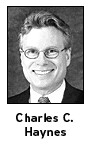
“This signals that religion finally does have a place in the public school curriculum in ways that are constitutional and educational,” said Charles C. Haynes, the senior scholar at the First Amendment Center, which promotes First Amendment freedoms. The center—which is financed by the Freedom Forum and has offices in Nashville, Tenn., New York City, and Arlington, Va.— collaborated on the two-year study with the Council on Islamic Education, a national group with headquarters in Fountain Valley, Calif.
|
The findings represent a sea change from the late 1980s, when a succession of national reports pointed out that the sensitive and potentially explosive subject had all but disappeared from schools. By 1998, however, textbook reviews had begun to show that coverage of religion, while still spotty, was expanding in history and social studies textbooks.
Released last week, the new study focuses on the voluntary national standards created for the teaching of social studies, history, geography, civics and government, and economics, as well as the curricular standards drafted by most states throughout the 1990s. The latter are particularly important because in states with standards and testing systems, they lay the groundwork for what gets taught and tested in schools.
For the most part, the analysis found, the state curricular guidelines mirror the national documents. The extent to which the state standards cover religion depends on the model they follow. References to religion abound, for example, in the national U.S. and world history standards, which influenced the development of curricular guidelines in 17 states. The report cites 158 references to religion in those documents.
Social studies teaching guidelines written by the National Council for the Social Studies, on the other hand, contain only 21 specific references to religion. But among the 19 states relying on that model, many also “plug in” standards for other specific disciplines or subdisciplines, such as history or geography.
‘Frozen in Time’
Despite the stepped-up coverage, the treatment of religion in state and national standards still leaves much to be desired, according to the study. Some of the shortfalls noted in the report include:
• Scant treatment of the subject in the early grades;
• Little mention of religion in American life in connection with the study of the 20th century; and
• Only “thumbnail sketches” of major non-Western religions in world history standards, even though world history is increasingly becoming a required course in schools.
“There’s not much attention to how these religions develop, expand, and change,” Mr. Haynes said. “With the exception of Christianity, other faiths are frozen in time.”
The report also contains little information on the extent to which the standards laid out on paper have carried over to the teaching that goes on in classrooms.
“The hard-to-find news is how deeply students and teachers are delving into the study of religions,” said Don Ernst, the director of government relations for the Association for Supervision and Curriculum Development in Alexandria, Va. “Intuition tells us it’s still one of the neglected areas of the social studies curriculum.”
Part of the problem, experts say, is a lack of professional development and preservice education about religion for teachers, who may feel uncomfortable addressing religious topics. And litigation over issues such as school prayer may have left the impression that any discussion about religion in the public schools is forbidden. Some doubts also exist over whether state assessments include questions on religion.
Still, “we’ve moved beyond talking about the fact that religion was largely ignored to talking about how well it’s treated,” Mr. Haynes said. “That’s improvement.”


