In established professions, licensing tests are based on the body of knowledge that practitioners have decided newcomers must know. But in teaching, that has not been the case.
Until now.
The Educational Testing Service announced last week that it was revamping its PRAXIS tests to reflect the standards for teachers written by subject-matter associations.
Those standards for teacher preparation are used by the National Council for Accreditation of Teacher Education to make judgments about the quality of education school programs.
Aligning the tests with the standards that education schools are expected to meet should help produce better-educated teachers, said Sharon P. Robinson, the chief operating officer of the Princeton, N.J.-based ETS.
“This is the answer to the question, ‘What would we be doing, if what we were doing made sense?’” Ms. Robinson said at a press conference held here last week to announce a partnership with NCATE to revise the tests.
Matching teacher tests to standards for beginners is another step toward a fully integrated, standards-based education system.
Many of the subject-matter groups involved also have been instrumental in creating student academic standards that states and districts relied on to write their own standards documents.
Both the testing service and the accrediting group already have begun working together to redesign the elementary portion of the PRAXIS II tests. New tests could be available as soon as next June.
Over the next three to five years, the ETS plans to revamp the entire PRAXIS II series, a battery of exams that gauges teachers’ knowledge of their subjects. The tests first became available in 1993.
A Design Complement
The new tests would complement the accrediting body’s ongoing redesign of its system to focus less on coursework, and more on individual teacher-candidates’ demonstrated knowledge and skills.
That performance-based system, known as NCATE 2000, is scheduled to begin next year and affect all accredited institutions by 2006.
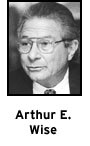
The emergence of professionally developed standards for teacher tests marks “a major move forward” for teaching, said Arthur E. Wise, the president of NCATE.
On a practical level, better tests will strengthen the accrediting system, he said. “We need for the tests to be as good as they can be so we can use them as one indicator of the success of our institutions.”
The announcement of a new generation of licensure tests comes at a time of intense focus on teacher supply and on the assessments used to screen new teachers to make sure they are qualified.
Under Title II of the Higher Education Act of 1998, institutions receiving federal aid are required to report publicly on how their education students fare on exams. (“Teacher Ed. Riled Over Federal Plan ,” Aug. 4, 1999.)
Transmitting Knowledge
Specifically, the ETS will work through NCATE with the various subject-matter groups--such as the International Reading Association--to write content specifications and review the new tests.

|
Work is already under way on the elementary exams, using new standards for elementary teachers drafted by NCATE.
The standards are written to describe what teacher-candidates should know and be able to do so that their students will learn. And institutions will be required to show how their students rated on the exams as part of the accreditation process.
Emerson Elliott, the director of program-standards development for NCATE, noted that the new PRAXIS tests would not, by themselves, evaluate all the elementary standards.
Teacher education institutions will be expected to sample and summarize a wide variety of information about their students, he said, including coursework and practice teaching, arts and sciences subject knowledge, and on-the-job evaluations.
The new tests are expected to be made up of multiple-choice questions and essays written to assess prospective teachers’ understanding of their disciplines and how to teach those subjects to children.
Currently, the tests sample a teacher-candidate’s knowledge of a subject field, but they don’t evaluate whether he or she can help students learn and figure out, for example, where a student’s misconceptions are impeding learning.
The new tests aren’t expected to cost candidates any more than the current version of PRAXIS, Ms. Robinson said. Prospective teachers pay between $45 and $60 to take those tests.
A Supply Hindrance?
Whether there will be a market for more rigorous tests, however, remains to be seen. Of the 36 states that require Praxis, many don’t use the PRAXIS II tests for elementary teachers, instead requiring candidates for licensure to take the PRAXIS I basic-skills test. PRAXIS I was intended to be used by education schools to screen students for admission.
Given states’ concern over the widespread need for new teachers, testing officials acknowledged that the new, tougher exams would have to be marketed aggressively.
Though states generally have been raising the passing scores on teacher tests, and some are adopting a more rigorous menu of tests, policymakers are wary of decreasing the pool of new teachers.
“Nobody asked us to do this except our colleagues in the professional community,” Ms. Robinson said. “Part of the risk and challenge to the professional community is to create a demand for quality measurement tools at the elementary level.”
|
Adopting a new teacher licensing test is “a highly politically charged process” for states, observed Virginia Roach, the deputy executive director of the National Association of State Boards of Education.
“That’s easier to implement in times when you don’t have a teacher shortage knocking at the door.”


