Law & Courts

Supreme Court to Decide Whether Nonlawyer Parents May Sue Under IDEA

By Andrew Trotter — October 27, 2006 2 min read
  • Save to favorites
  • Print

The U.S. Supreme Court today agreed to decide whether parents who are not lawyers have a right to represent their child with disabilities, or themselves, in federal court under the federal Individuals with Disabilities Education Act.

The Bush administration had urged the justices to take up the issue, on which various federal appeals courts had issued conflicting rulings in recent years.

The appeal stems from a lawsuit by Jeff and Sandee Winkelman, two Ohio parents who challenged the appropriateness of a school’s educational plan for their son, Jacob, who has autism spectrum disorder.

After several administrative hearings at which the parents represented their son, the Winkelmans sued the 13,000-student Parma school district in U.S District Court in Cleveland, challenging the hearing officers’ decisions that the district had provided their son a free, appropriate public education as required under the IDEA.

The district court ruled in favor of the school system in June 2005. The family appealed, but the U.S. Court of Appeals for the 6th Circuit, in Cincinnati, ruled last November that the parents could not proceed in that court without a lawyer.

The parents appealed to the Supreme Court, and in May the justices asked the Bush administration to weigh in on Winkelman v. Parma City School District (Case No. 05-983).

Parents’ Derivative Rights?

In a brief filed Sept. 20, U.S. Solicitor General Paul D. Clement suggested that the 6th circuit holding, barring parents from representing themselves under the IDEA, was “inconsistent with the plain language, structure, and purposes of IDEA.”

“Resolution of this conflict is warranted in view of the critical interests involved in IDEA litigation, the recurring nature of the question presented, and the need to ensure IDEA’s uniform application,” the brief said.

The Parma school district, in a brief opposing Supreme Court review, argued that the IDEA allows parents to represent their children in state administrative proceedings under the federal law, but not in federal court proceedings.

At stake, the district argued in its brief, is the quality of representation of the child, because “minor children with disabilities cannot make an informed choice to assume the risk of proceeding without counsel.”

The Supreme Court has not addressed whether parents are entitled to sue on their own behalf under the IDEA or whether their right to file an IDEA lawsuit derives from their child’s rights under the law, according to solicitor general’s brief.

The issue of whether the right is derivative is key, Mr. Clement argued, because a nonlawyer parent can only represent himself or herself and not the parent’s child.

While the 6th Circuit court held that nonlawyer parents may not press an IDEA case in federal court under any circumstance, another federal appeals court has ruled that nonlawyer parents are not limited at all. Four other appeals courts have held that such parents need a lawyer to press a child’s substantive claims under the IDEA, but not the parents’ procedural claims.

The court granted review of the case on Oct. 27, and it will likely hear arguments in the case sometime early next year.

Related Tags:

Events

This content is provided by our sponsor. It is not written by and does not necessarily reflect the views of Education Week's editorial staff.
Sponsor
Artificial Intelligence Webinar
Managing AI in Schools: Practical Strategies for Districts
How should districts govern AI in schools? Learn practical strategies for policies, safety, transparency, as well as responsible adoption.
Content provided by Lightspeed Systems
This content is provided by our sponsor. It is not written by and does not necessarily reflect the views of Education Week's editorial staff.
Sponsor
Reading & Literacy Webinar
Unlocking Success for Struggling Adolescent Readers
The Science of Reading transformed K-3 literacy. Now it's time to extend that focus to students in grades 6 through 12.
Content provided by STARI
Jobs Virtual Career Fair for Teachers and K-12 Staff
Find teaching jobs and K-12 education jubs at the EdWeek Top School Jobs virtual career fair.

EdWeek Top School Jobs

Teacher Jobs
Search over ten thousand teaching jobs nationwide — elementary, middle, high school and more.
View Jobs
Principal Jobs
Find hundreds of jobs for principals, assistant principals, and other school leadership roles.
View Jobs
Administrator Jobs
Over a thousand district-level jobs: superintendents, directors, more.
View Jobs
Support Staff Jobs
Search thousands of jobs, from paraprofessionals to counselors and more.
View Jobs

Read Next

Law & Courts Appeals Court Blocks Ruling Bolstering Parental Rights Over Gender Identity
A federal appeals court blocked a groundbreaking ruling over the disclosure of students' gender identities.
4 min read
Students carrying pride flags and transgender flags leave Great Oak High School on Sept. 22, 2023, in Temecula, Calif., after walking out of the school in protest of the Temecula school district policy requiring parents to be notified if their child identifies as transgender.
Students carrying pride flags and transgender flags leave Great Oak High School on Sept. 22, 2023, in Temecula, Calif., after walking out of the school in protest of the Temecula school district policy requiring parents to be notified if their child identifies as transgender. But many districts in California follow a state policy limiting when schools can inform parents about a student's gender identity without the student's consent.
Anjali Sharif-Paul/The Orange County Register via AP
Law & Courts Appeals Court Halts Ruling Letting Teachers Disclose Students' Gender Identity
A federal appeals court has temporarily paused enforcement of the ruling but has not yet decided whether to grant a longer-term stay.
Kristen Taketa, The San Diego Union-Tribune
3 min read
Students carrying pride and transgender flags leave Great Oak High School in Temecula, Calif., on Sept. 22, 2023, after walking out of the school in protest of the Temecula school district policy requiring parents to be notified if their child identifies as transgender.
Anjali Sharif-Paul/The Orange County Register via AP
Law & Courts Schools Can’t Bar Teachers From Telling Parents If Kids Are Transgender, Judge Rules
The injunction bans any public school employee from misleading parents about their child’s gender presentation at school.
Kristen Taketa, The San Diego Union-Tribune
5 min read
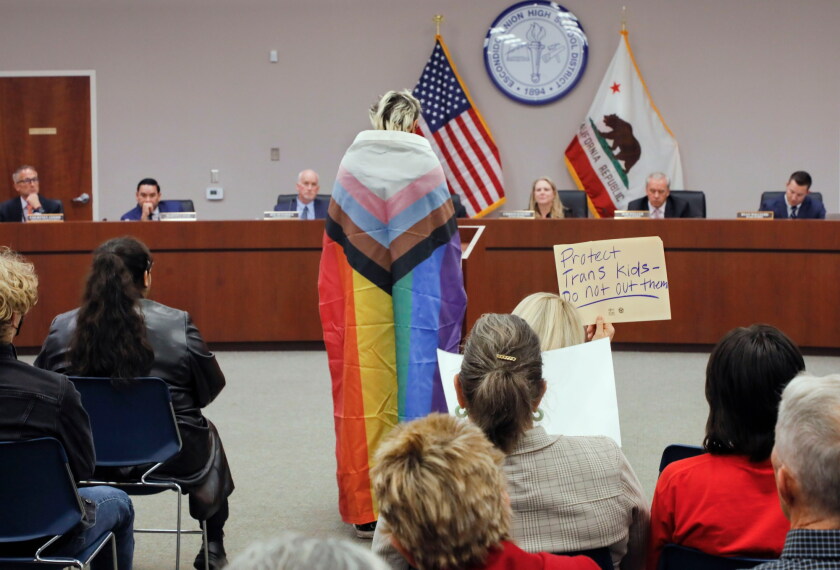
Teacher’s aide Amelia Mester, wrapped in a Pride flag, urges Escondido Union High School District not to have employees notify parents if they believe a student may be transgender in November 2025. A policy on the issue in the city’s elementary school district is the subject of a federal class-action lawsuit in which a judge just sided against the district.
Teacher’s aide Amelia Mester, wrapped in a Pride flag, urges Escondido Union High School District not to have employees notify parents if they believe a student may be transgender. A policy on the issue in the city’s elementary school district is the subject of a federal class-action lawsuit in which a judge just ruled against the district.
Charlie Neuman for The San Diego Union-Tribune/TNS
Law & Courts Federal Appeals Court Upholds 8th Grader's Expulsion Over Gun Comments in Class
Shortly after a nearby mass school shooting, a student allegedly discussed bringing a gun to school.
3 min read
Photo of stone columns.
E+