Federal

School Accountability Systems Seen as Unlikely to Face Major Overhaul

By Lynn Olson — January 29, 2007 4 min read
  • Save to favorites
  • Print

Policy experts and scholars gathered here last week cited chapter and verse about the negative consequences of the No Child Left Behind Act’s reliance on state tests to judge schools.

But there was less agreement about what a better alternative might look like, and even less optimism that one would come to pass.

At a conference at the University of California, Los Angeles, on the future of test-based accountability systems, participants did offer some ideas for how to address the unintended consequences of such systems. Those perceived effects range from a narrowing of the curriculum to a focus on low-level skills at the expense of more-ambitious learning targets.

But the consensus at the Jan. 22-23 meeting, which was hosted by the National Center for Research on Evaluation, Standards, and Student Testing, or CRESST, seemed to be that tweaks, rather than big revisions, in test-based accountability are most likely in the near term.

The conference was held in honor of Robert L. Linn, who has been a director of the federally funded research center since its founding in 1985. Mr. Linn, a professor emeritus of education at the University of Colorado at Boulder, has written extensively about what he sees as problems with the federal No Child Left Behind law.

Those include the lack of evidence that all students can score at the “proficient” level on state tests by 2014, as the law requires; the wide variations in how states define proficiency; and the inability to draw firm conclusions about school quality based on test scores alone.

Mr. Linn has proposed using test results as “descriptive information” to flag schools that need a closer look at their instructional and organizational practices, rather than as the final determinant of whether schools should receive rewards or sanctions.

But Lorraine M. McDonnell, a professor of political science at the University of California, Santa Barbara, cautioned that while test-based accountability might appear “ripe for major change,” it is likely to remain the dominant paradigm for the next five to 10 years.

That’s because the core idea of using externally imposed measures to judge schools is deeply entrenched, she said, and in part because critics have yet to offer a compelling alternative idea. “In the end, I’d say, it’s all about the ideas, or the lack thereof,” she said.

‘Merit Badges’

Daniel Koretz, a professor of education at the Harvard University’s graduate school of education, suggested that states routinely include test items with unfamiliar formats as part of their testing systems to help detect whether the gains reflected on such tests reflect real learning on the part of students or narrower test-preparation activities.

He also said that the reauthorization of the 5-year-old federal law, scheduled for this year, could offer waivers to states to experiment with different forms of educational accountability and gather evidence on their effects.

Eva L. Baker, a UCLA professor of education and a co-director of CRESST, raised the idea of giving up on trying to change state tests, which will always be constrained by the costs and logistics involved, she said.

Instead, she suggested finding other ways to recognize students’ accomplishments across a broad array of important domains by permitting students to accumulate a series of qualifications, or what Albert Shanker, the late president of the American Federation of Teachers, called “merit badges.”

Such badges could range from completing writing or research projects to Web-based instructional modules. Students could then use those unique portfolios for review by employers or colleges.

Forget Perfection

Others at the meeting suggested focusing more on instructional interventions that could improve schools, and on increasing the capacity of educators to teach differently based on research.

“Transforming education to allow all children to reach their potential is not, primarily, an accountability problem; it’s a teaching and learning problem,” said Joan L. Herman, another CRESST director and professor of education at UCLA.

“Is accountability serving the public interest?” she said. “I still say yes, though we need to and can do better.”

Bella Rosenberg, an independent consultant who used to work for the AFT, said if policymakers were serious about closing achievement gaps among students from different demographic groups, they would pay more attention to tackling out-of-school factors that influence achievement and to attacking socioeconomic inequities.

“American teachers are, by and large, heartsick and very angry over this law,” she added of the No Child Left Behind Act.

Yet while some changes in the NCLB law may be advisable, “I actually hope [the law] doesn’t fall apart,” said Michael J. Feuer, the executive director of the National Academies’ Division of Behavioral and Social Sciences and Education. The alternative could be accountability based solely on markets, he said, and that could be even less desirable.

“This is big stuff,” he said. “It’s complicated. And if the standard of evidence is perfection, forget it.”
A version of this article appeared in the January 31, 2007 edition of Education Week as School Accountability Systems Seen as Unlikely to Face Major Overhaul

Events

This content is provided by our sponsor. It is not written by and does not necessarily reflect the views of Education Week's editorial staff.
Sponsor
Artificial Intelligence Webinar
Managing AI in Schools: Practical Strategies for Districts
How should districts govern AI in schools? Learn practical strategies for policies, safety, transparency, as well as responsible adoption.
Content provided by Lightspeed Systems
This content is provided by our sponsor. It is not written by and does not necessarily reflect the views of Education Week's editorial staff.
Sponsor
Reading & Literacy Webinar
Unlocking Success for Struggling Adolescent Readers
The Science of Reading transformed K-3 literacy. Now it's time to extend that focus to students in grades 6 through 12.
Content provided by STARI
Jobs Virtual Career Fair for Teachers and K-12 Staff
Find teaching jobs and K-12 education jubs at the EdWeek Top School Jobs virtual career fair.

EdWeek Top School Jobs

Teacher Jobs
Search over ten thousand teaching jobs nationwide — elementary, middle, high school and more.
View Jobs
Principal Jobs
Find hundreds of jobs for principals, assistant principals, and other school leadership roles.
View Jobs
Administrator Jobs
Over a thousand district-level jobs: superintendents, directors, more.
View Jobs
Support Staff Jobs
Search thousands of jobs, from paraprofessionals to counselors and more.
View Jobs

Read Next

Federal Trump Talks Up AI in State of the Union, But Not Much Else About Education
The president didn't mention two of his cornerstone education policies from the past year.
4 min read
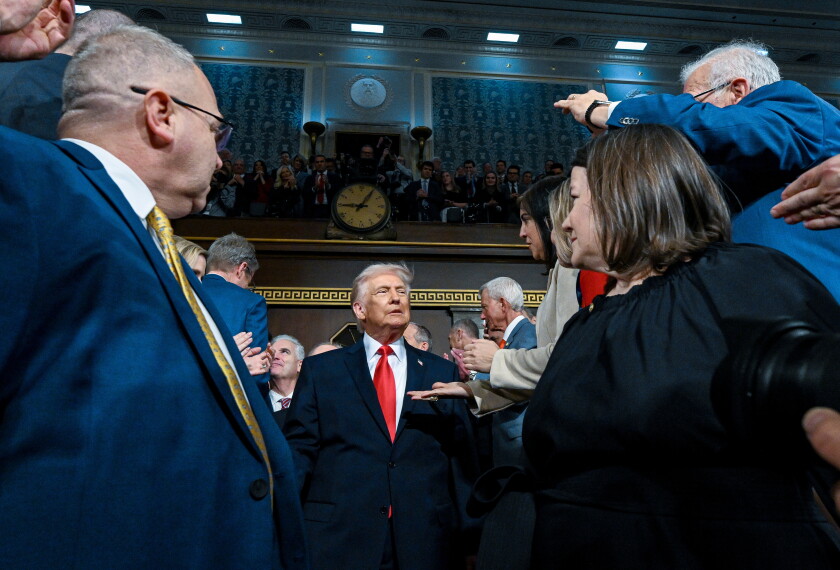
President Donald Trump enters to deliver the State of the Union address to a joint session of Congress in the House chamber at the U.S. Capitol in Washington, Tuesday, Feb. 24, 2026.
President Donald Trump enters to deliver the State of the Union address to a joint session of Congress in the House chamber at the U.S. Capitol in Washington, Tuesday, Feb. 24, 2026. The president devoted little time in the speech to discussing his education policies.
Kenny Holston/The New York Times via AP, Pool
Federal Education Department Will Send More of Its Programs to Other Agencies
Education grants for school safety, community schools, and family engagement will shift to Health and Human Services.
4 min read
Various school representatives and parent liaisons attend a family and community engagement think tank discussion at Lowery Conference Center on March 13, 2024 in Denver. One of the goals of the meeting was to discuss how schools can better integrate new students and families into the district. Denver Public Schools has six community hubs across the district that have serviced 3,000 new students since October 2023. Each community hub has different resources for families and students catering to what the community needs.
A program that helps state education departments and schools improve family engagement policies is among those the Trump administration will transfer from the U.S. Department of Education to the U.S. Department of Health and Human Services. In this photo, school representatives and parent liaisons attend a family and community engagement discussion on March 13, 2024, in Denver to discuss how schools can better integrate new students and families into the district.
Rebecca Slezak For Education Week
Federal New Trump Admin. Guidance Says Teachers Can Pray With Students
The president said the guidance for public schools would ensure "total protection" for school prayer.
3 min read
MADISON, AL - MARCH 29: Bob Jones High School football players touch the people near them during a prayer after morning workouts and before the rest of the school day on March 29, 2024, in Madison, AL. Head football coach Kelvis White and his brother follow in the footsteps of their father, who was also a football coach. As sports in the United States deals with polarization, Coach White and Bob Jones High School form a classic tale of team, unity, and brotherhood. (Photo by Jahi Chikwendiu/The Washington Post via Getty Images)
Football players at Bob Jones High School in Madison, Ala., pray after morning workouts before the rest of the school day on March 29, 2024. New guidance from the U.S. Department of Education says students and educators can pray at school, as long as the prayer isn't school-sponsored and disruptive to school and classroom activities, and students aren't coerced to participate.
Jahi Chikwendiu/Washington Post via Getty Images
Federal Ed. Dept. Paid Civil Rights Staffers Up to $38 Million as It Tried to Lay Them Off
A report from Congress' watchdog looks into the Trump Admin.'s efforts to downsize the Education Department.
5 min read
Commuters walk past the headquarters of the U.S. Department of Eduction, which were ordered closed for the day for what officials described as security reasons amid large-scale layoffs, on March 12, 2025, in Washington.
The U.S. Department of Education spent up to $38 million last year to pay civil rights staffers who remained on administrative leave while the agency tried to lay them off.
Mark Schiefelbein/AP
