Law & Courts

Pennsylvania Governor, School Boards in Taxing Tussle

By Catherine Gewertz — April 12, 2005 4 min read
  • Save to favorites
  • Print

Homeowners across Pennsylvania have signed up for a new property-tax cut. But their local school boards hold the power to activate those reductions, and only a handful have agreed to do so.

The Keystone State’s 501 school districts have until May 30 to decide whether to “opt in” to Act 72, which was enacted last July in first-term Democratic Gov. Edward G. Rendell’s bid to deliver on promises to lower property taxes and increase the state’s share of school funding. Only four districts so far have chosen to participate.
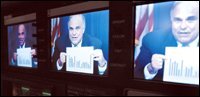
Gov. Edward G. Rendell of Pennsylvania is lobbying school boards to accept slot machine revenue as a way to lower property taxes.

Act 72 and its companion measure, Act 71, allow slot machines in Pennsylvania, and funnel a share of the proceeds to consenting school districts to use—along with a required boost in the local earned-income tax—to lower property taxes. The formula essentially substitutes state money for a chunk of the local revenue that supports schools.

Homeowners have been seeking relief from property taxes that have risen more than 60 percent in the past dozen years. By some estimates, 70 percent of homeowners have applied for Act 72 reductions.

But school boards have been slow to sign on, prompting criticism by some that they are protecting their unfettered taxing power at citizens’ expense. Gov. Rendell has launched a series of public appearances urging voters to press school boards to opt in.

“It’s topic number one in Pennsylvania right now,” said G. Terry Madonna, a veteran political analyst who directs the Center for Politics and Public Affairs at Franklin & Marshall College in Lancaster, Pa. “This is as big an issue as I’ve seen in a decade among the education community.”

‘Love and Support’

School boards and education groups contend there are too many unresolved questions about the law’s impact to opt in by the May 30 deadline. They say they should have more time, since slot-machine proceeds are not expected to be distributed until 2007. Moves afoot in the courts and the legislature could extend that deadline, a delay the governor views as unnecessary.

Chief among school boards’ concerns is a “back-end referendum” provision that requires school districts to get voters’ permission to raise property taxes above an inflation-pegged index if they decide to accept the gambling revenue. School boards in Pennsylvania have never had to ask voters if they can raise taxes, and some fear the mechanism could result in cutbacks.

“If it’s the only tax [citizens] get to vote on, what do you expect they’re going to do?” said William H. Johnson, a spokesman for the Pennsylvania State Education Association, a National Education Association affiliate. The 173,000-member state union is also concerned because the law will force districts to draft budgets several months earlier, with scarce information about the coming year’s state funds.

If gambling proceeds reach $1 billion, as the state hopes, they will enable average property-tax cuts of 20 percent, or about $330 per homeowner. But Joseph Bard, the executive director of the Pennsylvania Association of Rural and Small Schools, said some people wonder whether proceeds might fall short, limiting the boards’ taxing power in exchange for only a modest homeowner benefit.

Gov. Rendell’s secretary of planning and policy, Donna Cooper, argues that Act 72 moves the state toward a fairer tax structure. Combined with recent increases in state aid for public schools, and a first-ever extra increase for the financially neediest districts, the law will raise the state’s share of school funding from 36 percent to 44 percent by 2006, she said.

Ten exceptions to the law ensure that it won’t put districts in a financial straitjacket, Ms. Cooper said. Districts that opt in may raise taxes above the index without voter permission to finance, for instance, expenses for special education or the federal No Child Left Behind Act.

The state law offers a potent political benefit to districts, said Ms. Cooper: Pennsylvania homeowners—most of whom do not have children in public schools—will “love and support” their schools more if districts are not taxing them so heavily.

Limited Power

Assuming most districts ultimately opt in, Act 72 would bring Pennsylvania more into line with other states, said Mike Griffith, a school finance expert for the Education Commission of the States, based in Denver. In most states, local school boards have no taxing power, or face a cap or voter-permission requirement when they wish to raise taxes, he said.

“Pennsylvania is the only state I know of where there is no limit for how much a local school board can increase local property taxes,” Mr. Griffith said. “They have essentially a blank check.”

Some who favor reduced school spending maintain the law is too weak. Matthew J. Brouillette, the director of the Commonwealth Foundation, a conservative-leaning think tank based in Harrisburg, the state capital, said Act 72 is “toothless” because of the 10 exceptions.

Many educators believe policymakers should go beyond the debate over Act 72, and revamp how Pennsylvania finances its schools. Richard D. Nilsen, the superintendent of the 3,600-student Dover Area school district, said property values enable his wealthier neighbors to generate $2 million from raising taxes by 1 mill, compared with just $833,000 in his district.

“Unless we get real estate out of the picture, we’ll never solve the equity issue,” he said.

Related Tags:

Events

This content is provided by our sponsor. It is not written by and does not necessarily reflect the views of Education Week's editorial staff.
Sponsor
School & District Management Webinar
Too Many Initiatives, Not Enough Alignment: A Change Management Playbook for Leaders
Learn how leadership teams can increase alignment and evaluate every program, practice, and purchase against a clear strategic plan.
Content provided by Otus
This content is provided by our sponsor. It is not written by and does not necessarily reflect the views of Education Week's editorial staff.
Sponsor
Artificial Intelligence Webinar
Beyond Teacher Tools: Exploring AI for Student Success
Teacher AI tools only show assigned work. See how TrekAi's student-facing approach reveals authentic learning needs and drives real success.
Content provided by TrekAi
This content is provided by our sponsor. It is not written by and does not necessarily reflect the views of Education Week's editorial staff.
Sponsor
College & Workforce Readiness Webinar
Building for the Future: Igniting Middle Schoolers’ Interest in Skilled Trades & Future-Ready Skills
Ignite middle schoolers’ interest in skilled trades with hands-on learning and real-world projects that build future-ready skills.
Content provided by Project Lead The Way

EdWeek Top School Jobs

Teacher Jobs
Search over ten thousand teaching jobs nationwide — elementary, middle, high school and more.
View Jobs
Principal Jobs
Find hundreds of jobs for principals, assistant principals, and other school leadership roles.
View Jobs
Administrator Jobs
Over a thousand district-level jobs: superintendents, directors, more.
View Jobs
Support Staff Jobs
Search thousands of jobs, from paraprofessionals to counselors and more.
View Jobs

Read Next

Law & Courts Supreme Court Backs Parents in School Gender Disclosure Fight
The Supreme Court restored an injunction blocking California policies on student gender transitions
8 min read
Teacher’s aide Amelia Mester, wrapped in a Pride flag, urges Escondido Union High School District not to have employees notify parents if they believe a student may be transgender in November 2025. A policy on the issue in the city’s elementary school district is the subject of a federal class-action lawsuit in which a judge just sided against the district.
Teacher’s aide Amelia Mester, wrapped in a Pride flag, urges Escondido Union High School District not to have employees notify parents if they believe a student may be transgender at a meeting in November 2025. Two parents and two teachers from the district sued in 2023, challenging California state guidance concerning student gender transitions and parental notification. The U.S. Supreme Court has now reinstated a lower-court decision overturning those state policies.
Charlie Neuman for The San Diego Union-Tribune/TNS
Law & Courts Appeals Court Allows Louisiana Ten Commandments Displays to Proceed
The court said it was premature to rule on the constitutionality of La. Ten Commandments displays.
3 min read
Students work under Ten Commandments and Bill of Rights posters on display in a classroom at Lehman High School in Kyle, Texas, Thursday, Oct. 16, 2025.
Students work under Ten Commandments and Bill of Rights posters on display in a classroom at Lehman High School in Kyle, Texas, Oct. 16, 2025. A federal appeals court has lifted a lower-court injunction blocking a Louisiana law that requires Ten Commandments displays, clearing the way for the law to take effect.
Eric Gay/AP
Law & Courts Social Media Companies Face Legal Reckoning Over Mental Health Harms to Children
Some of the biggest players from Meta to TikTok are getting a chance to make their case in courtrooms around the country.
6 min read
Social Media Kids Trial 26050035983057
Meta CEO Mark Zuckerberg leaves court after testifying in a landmark trial over whether social media platforms deliberately addict and harm children, on Feb. 18, 2026, in Los Angeles.
AP Photo/Damian Dovarganes
Law & Courts Supreme Court Strikes Trump Tariffs in Case Brought by Educational Toy Companies
Two educational toy companies were among the leading challengers to the president's tariff policies
3 min read
Members of the Supreme Court sit for a new group portrait following the addition of Associate Justice Ketanji Brown Jackson, at the Supreme Court building in Washington, Oct. 7, 2022. Bottom row, from left, Associate Justice Sonia Sotomayor, Associate Justice Clarence Thomas, Chief Justice of the United States John Roberts, Associate Justice Samuel Alito, and Associate Justice Elena Kagan. Top row, from left, Associate Justice Amy Coney Barrett, Associate Justice Neil Gorsuch, Associate Justice Brett Kavanaugh, and Associate Justice Ketanji Brown Jackson.
Members of the U.S. Supreme Court sit for a new group portrait following the addition of Justice Ketanji Brown Jackson, at the court building in Washington, Oct. 7, 2022. On Feb. 20, 2026, the court ruled 6-3 to strike down President Donald Trump's broad tariff policies, ruling that they were not authorized by the federal statute that he cited for them.
J. Scott Applewhite/AP
