Law & Courts

Ohio Court Declares End To DeRolph School Funding Case

By Mary Ann Zehr — May 28, 2003 | Corrected: June 18, 2003 2 min read
  • Save to favorites
  • Print

Corrected: Robert A. Gardner is the Republican who chairs the education committee of the state Senate. We accidentally misspelled his name in this story.

The Ohio Supreme Court has issued its final decision on a state school funding case that has persisted for 12 years.

In the May 16 ruling, the court reiterated its judgment in several previous rulings that the system for financing education violates the state constitution, and that the duty to fix the problem lies with the legislature. (“Ohio Court Rejects State School Aid System,” Jan. 8, 2003.)

But in its 5-2 final ruling, the court also made clear that the long-running case was over—that neither the state high court itself or “any other court” has jurisdiction over the case. That declaration leaves the plaintiffs no mechanism, at least as far as the court is concerned, to ensure that the current unconstitutional system is fixed.

“It’s like the court said, ‘You are guilty but you are free,’” said William L. Phillis, the executive director of the Columbus-based Ohio Coalition for Equity and Adequacy of School Funding, which filed the lawsuit against the state, called DeRolph v. State of Ohio, in 1991.

He said the chances that the legislature would fix the current funding system were slim now, given that the legislature didn’t fundamentally fix the system during the years that the court maintained jurisdiction over the case.

The final ruling was a response to an effort by the plaintiffs to get a lower-court judge—Perry County Common Pleas Court Judge Linton D. Lewis Jr.— to supervise a conference on how the legislature would comply with the supreme court’s judgment.

Ohio Attorney General Jim Petro asked the supreme court to deny that request. In its final ruling, the court clarified that indeed the case was over and no further action regarding it should occur in any state court.

Not in Vain

Gov. Bob Taft, a Republican, recognizes that he and the legislature have the responsibility to make sure the state’s education system is “thorough and efficient,” as required by the Ohio Constitution, said Ann Husted, his communications director.

But “on the same level,” she added, “the governor has the constitutional responsibility to balance the budget.” The budget for fiscal 2004 is now being debated in the state Senate.

Sen. Robert Garner, a Republican who is the chairman of the Senate education committee, said the legislature has already done a lot in the past 10 years to address the problems with the funding system.

He argued, for example, that per-pupil funding for Ohio public school students has more than doubled since the DeRolph lawsuit was filed. And while from 1954 to 1997, the state spent only $174 million on school facilities, it has spent $3.6 billion on such facilities since 1997. “The urgency is over,” Mr. Garner said.

Mr. Phillis, whose group represents the plaintiffs, cited some of the same figures to demonstrate that the plaintiffs had not undertaken the DeRolph lawsuit in vain.

The state would never have increased its spending on school facilities to the extent that it did if his coalition hadn’t filed the lawsuit, Mr. Phillis asserted.

In addition, he said, the case caused the state to clarify that the legislature’s obligation to provide a “thorough and efficient” education to Ohio’s schoolchildren meant providing a high-quality education, not simply keeping school doors open.

However, he said, the state never did what the court had ordered it to do in its decisions.

“There’s been no structural change in the funding,” Mr. Phillis said. He added that lawmakers have failed to tie the funding level with the actual cost of providing a high-quality education.

Events

This content is provided by our sponsor. It is not written by and does not necessarily reflect the views of Education Week's editorial staff.
Sponsor
Artificial Intelligence Webinar
Managing AI in Schools: Practical Strategies for Districts
How should districts govern AI in schools? Learn practical strategies for policies, safety, transparency, and responsible adoption.
Content provided by Lightspeed Systems
This content is provided by our sponsor. It is not written by and does not necessarily reflect the views of Education Week's editorial staff.
Sponsor
Reading & Literacy Webinar
Two Jobs, One Classroom: Strengthening Decoding While Teaching Grade-Level Text
Discover practical, research-informed practices that drive real reading growth without sacrificing grade-level learning.
Content provided by EPS Learning
Jobs Virtual Career Fair for Teachers and K-12 Staff
Find teaching jobs and K-12 education jubs at the EdWeek Top School Jobs virtual career fair.

EdWeek Top School Jobs

Teacher Jobs
Search over ten thousand teaching jobs nationwide — elementary, middle, high school and more.
View Jobs
Principal Jobs
Find hundreds of jobs for principals, assistant principals, and other school leadership roles.
View Jobs
Administrator Jobs
Over a thousand district-level jobs: superintendents, directors, more.
View Jobs
Support Staff Jobs
Search thousands of jobs, from paraprofessionals to counselors and more.
View Jobs

Read Next

Law & Courts Appeals Court Halts Ruling Letting Teachers Disclose Students' Gender Identity
A federal appeals court has temporarily paused enforcement of the ruling but has not yet decided whether to grant a longer-term stay.
Kristen Taketa, The San Diego Union-Tribune
3 min read
Students carrying pride and transgender flags leave Great Oak High School in Temecula, Calif., on Sept. 22, 2023, after walking out of the school in protest of the Temecula school district policy requiring parents to be notified if their child identifies as transgender.
Anjali Sharif-Paul/The Orange County Register via AP
Law & Courts Schools Can’t Bar Teachers From Telling Parents If Kids Are Transgender, Judge Rules
The injunction bans any public school employee from misleading parents about their child’s gender presentation at school.
Kristen Taketa, The San Diego Union-Tribune
5 min read
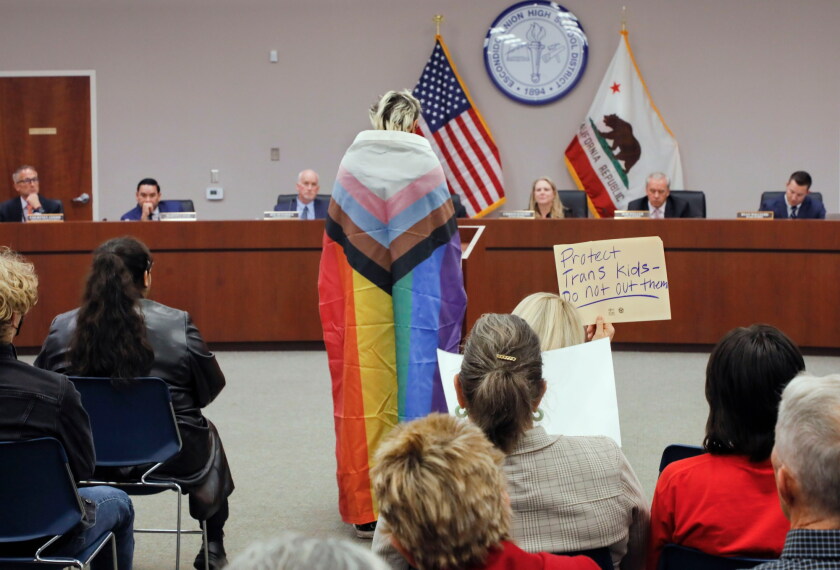
Teacher’s aide Amelia Mester, wrapped in a Pride flag, urges Escondido Union High School District not to have employees notify parents if they believe a student may be transgender in November 2025. A policy on the issue in the city’s elementary school district is the subject of a federal class-action lawsuit in which a judge just sided against the district.
Teacher’s aide Amelia Mester, wrapped in a Pride flag, urges Escondido Union High School District not to have employees notify parents if they believe a student may be transgender. A policy on the issue in the city’s elementary school district is the subject of a federal class-action lawsuit in which a judge just ruled against the district.
Charlie Neuman for The San Diego Union-Tribune/TNS
Law & Courts Federal Appeals Court Upholds 8th Grader's Expulsion Over Gun Comments in Class
Shortly after a nearby mass school shooting, a student allegedly discussed bringing a gun to school.
3 min read
Photo of stone columns.
E+
Law & Courts Trump's Education Policies Spurred 72 Lawsuits in 2025. How Many Is He Winning?
The legal challenges show which policies have had a big impact and how 2026 could go.
5 min read
President Donald Trump holds up an executive order after signing it at an indoor Presidential Inauguration parade event in Washington, Jan. 20, 2025.
President Donald Trump holds up an executive order after signing it at an indoor presidential inauguration parade event in Washington on Jan. 20, 2025. Trump's executive actions prompted legal challenges virtually from the moment he took office, and education-related policies were not immune.
Matt Rourke/AP
