Law & Courts

Kansas Supreme Court Orders Higher Spending for Schools

By Robert C. Johnston — June 03, 2005 1 min read
  • Save to favorites
  • Print

Saying time was of the essence, the Kansas Supreme Court ruled unanimously in a decision posted online June 3 that the state legislature has failed to satisfy a court mandate to adequately finance K-12 public schools. The court ordered lawmakers to double the increase in school aid approved for the 2005-06 school year by July 1.

The education budget for fiscal 2006, which became law on April 16 without Gov. Kathleen Sebelius’ signature, raises K-12 state aid by about $142 million, to nearly $2 billion over the current fiscal year. Under the new court-ordered remedy, the amount of the increase would total $285 million.

That increase is one-third of the $853 million recommended by a consulting firm retained by the legislature in 2001 to determine the cost of educating students in Kansas.

Funding beyond the 2005-06 school year will be contingent upon the results of a cost study ordered by the legislature this year. The court said that if that study is not completed in time for lawmakers to act on it in the 2006 session, or is not considered adequate by the court or is not acted on, the remaining two-thirds—or $568 million—in added funding recommended in the 2001 cost study could be ordered by the court.

A summary provided by the court said that the Kansas state board of education’s suggestion that the 2005 legislation be accepted as an interim step was “initially attractive.” The court, however, concluded that “… we cannot continue to ask current Kansas students to be patient. The time for their education is now.”

The court also delayed provisions passed by the legislature this year that would have authorized districts to raise local property taxes for education above state caps, and would have allowed for weighted state aid to reflect variations in local cost of living and radical shifts in local enrollment.

The June 3 decision is the latest action in the case known as Montoy v. State of Kansas, which was filed in 1999. On Jan. 3, the high court declared that the state inadequately finances its public schools, and ordered the legislature to adopt “corrective legislation” by April 12.

The budget passed by the legislature this spring increases per-pupil base spending from $3,863 to $4,222 annually, a hike of nearly 11 percent, and funding for special education and bilingual programs.

Events

This content is provided by our sponsor. It is not written by and does not necessarily reflect the views of Education Week's editorial staff.
Sponsor
Artificial Intelligence Webinar
Managing AI in Schools: Practical Strategies for Districts
How should districts govern AI in schools? Learn practical strategies for policies, safety, transparency, as well as responsible adoption.
Content provided by Lightspeed Systems
This content is provided by our sponsor. It is not written by and does not necessarily reflect the views of Education Week's editorial staff.
Sponsor
Reading & Literacy Webinar
Unlocking Success for Struggling Adolescent Readers
The Science of Reading transformed K-3 literacy. Now it's time to extend that focus to students in grades 6 through 12.
Content provided by STARI
Jobs Virtual Career Fair for Teachers and K-12 Staff
Find teaching jobs and K-12 education jubs at the EdWeek Top School Jobs virtual career fair.

EdWeek Top School Jobs

Teacher Jobs
Search over ten thousand teaching jobs nationwide — elementary, middle, high school and more.
View Jobs
Principal Jobs
Find hundreds of jobs for principals, assistant principals, and other school leadership roles.
View Jobs
Administrator Jobs
Over a thousand district-level jobs: superintendents, directors, more.
View Jobs
Support Staff Jobs
Search thousands of jobs, from paraprofessionals to counselors and more.
View Jobs

Read Next

Law & Courts Appeals Court Halts Ruling Letting Teachers Disclose Students' Gender Identity
A federal appeals court has temporarily paused enforcement of the ruling but has not yet decided whether to grant a longer-term stay.
Kristen Taketa, The San Diego Union-Tribune
3 min read
Students carrying pride and transgender flags leave Great Oak High School in Temecula, Calif., on Sept. 22, 2023, after walking out of the school in protest of the Temecula school district policy requiring parents to be notified if their child identifies as transgender.
Anjali Sharif-Paul/The Orange County Register via AP
Law & Courts Schools Can’t Bar Teachers From Telling Parents If Kids Are Transgender, Judge Rules
The injunction bans any public school employee from misleading parents about their child’s gender presentation at school.
Kristen Taketa, The San Diego Union-Tribune
5 min read
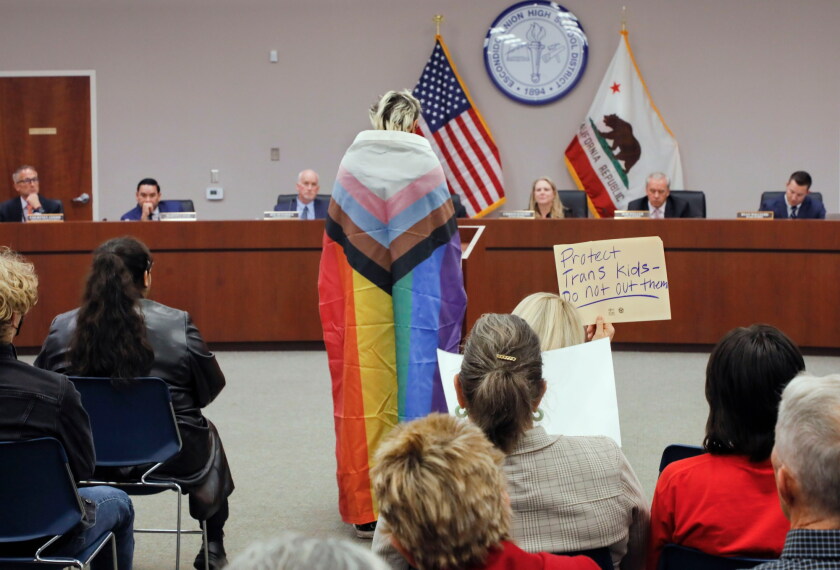
Teacher’s aide Amelia Mester, wrapped in a Pride flag, urges Escondido Union High School District not to have employees notify parents if they believe a student may be transgender in November 2025. A policy on the issue in the city’s elementary school district is the subject of a federal class-action lawsuit in which a judge just sided against the district.
Teacher’s aide Amelia Mester, wrapped in a Pride flag, urges Escondido Union High School District not to have employees notify parents if they believe a student may be transgender. A policy on the issue in the city’s elementary school district is the subject of a federal class-action lawsuit in which a judge just ruled against the district.
Charlie Neuman for The San Diego Union-Tribune/TNS
Law & Courts Federal Appeals Court Upholds 8th Grader's Expulsion Over Gun Comments in Class
Shortly after a nearby mass school shooting, a student allegedly discussed bringing a gun to school.
3 min read
Photo of stone columns.
E+
Law & Courts Trump's Education Policies Spurred 72 Lawsuits in 2025. How Many Is He Winning?
The legal challenges show which policies have had a big impact and how 2026 could go.
5 min read
President Donald Trump holds up an executive order after signing it at an indoor Presidential Inauguration parade event in Washington, Jan. 20, 2025.
President Donald Trump holds up an executive order after signing it at an indoor presidential inauguration parade event in Washington on Jan. 20, 2025. Trump's executive actions prompted legal challenges virtually from the moment he took office, and education-related policies were not immune.
Matt Rourke/AP
