The U.S. Supreme Court made clear last week that it would not have an easy time laying down the law on whether government displays of the Ten Commandments pass constitutional muster, and if so, under what circumstances.
“It’s so hard to draw that line,” Justice Sandra Day O’Connor said at one point, cutting to the heart of two hours of arguments in a pair of cases being watched closely by experts in education law.

Beneath a courtroom frieze depicting a tablet-toting Moses amid ancient lawgivers, the justices probed ideas along the spectrum of opinion toward displays of the Decalogue. The last time the high court grappled with the issue was in its 1980 ruling in Stone v. Graham, in which it struck down a Kentucky law requiring that the commandments be posted in all public schools. (“Ten Commandments Case Watched Closely by School Community,” Feb. 23, 2005.)
In the first case argued on March 2, Duke University law professor Erwin Chemerinsky told the court that a granite monument with a Protestant version of the commandments on the Texas State Capitol’s grounds violates the U.S. Constitution’s prohibition of government-established religion.
By displaying a sacred text in which “God is dictating to God’s followers rules for behavior,” the state is unconstitutionally turning nonbelievers and those of other faiths into outsiders, Mr. Chemerinsky argued. He represents a Texas man whose appeal is before the court in Van Orden v. Perry (Case No. 03-1500).
Taking a characteristically dim view of such arguments, Justice Antonin Scalia said the monument is “a symbol of the fact that government derives its authority from God.” The vast majority of Americans share that view, he said, and the minority must tolerate that fact.
Justice Anthony M. Kennedy cited what he called “a lack of balanced dialogue” and an “obsessive concern with religion” among opponents of the Texas monument. The U.S. Court of Appeals for the 5th Circuit, in New Orleans, held the monument to be constitutional in late 2003.
“If any atheist walks by, he can avert his eyes,” Justice Kennedy said.
Given that the Texas commandments monument was donated in 1961 by the Fraternal Order of Eagles of Texas, Justice John Paul Stevens suggested that the state could fence it in, deed away the underlying land, and put up a disclaimer saying the state does not endorse its content.
But acting U.S. Solicitor General Paul D. Clement, who joined Texas Attorney General Greg Abbott in arguing that the monument passes muster, said such a move would be bending over too far in the direction of impermissible government hostility toward religion.
Questioning Mr. Clement, Justice Ruth Bader Ginsburg asked whether commandments displays in other government settings were equally acceptable.
“What about every schoolroom, if that’s the choice of the school board?” she asked.
Mr. Clement replied that unless the court wanted to revisit its ruling in Stone v. Graham, the constitutionality of Ten Commandments displays in schools “is a much more difficult question.”
As in the Texas dispute, context was a huge issue in arguments over the Kentucky case, McCreary County v. American Civil Liberties Union of Kentucky (No. 03-1693). The case concerns displays in two Kentucky courthouses that were struck down as unconstitutional in late 2003 by the U.S. Court of Appeals for the 6th Circuit, in Cincinnati, which at the same time invalidated similar displays in the public schools of Harlan County, Ky. An appeal of that case, and another one from Ohio, have been put on hold as the high court considers the cases argued last week.
Display Called Sham
In the Kentucky courthouse case, the displays consisted of single, framed copies of the commandments. After the ACLU’s challenge, the counties surrounded them with other political and patriotic texts and symbols, from the Magna Carta and the Declaration of Independence to “The Star Spangled Banner.”
David A. Friedman, a lawyer from Louisville, Ky., who argued the ACLU’s case, told the justices that the extra documents were a “sham” to mask the counties’ religious purpose in mounting their displays. “That is simply wrapping the Ten Commandments in the flag,” he said.
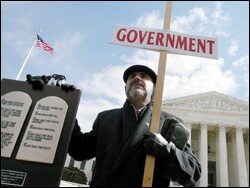
Justice David H. Souter seemed to agree, when he told Mathew D. Staver, a Longwood, Fla., lawyer who presented arguments for Kentucky’s McCreary and Pulaski counties, that “everybody knows that the present context is just litigation dressing.”
Mr. Staver responded that the counties “chose to switch rather than fight,” and that government officials must be allowed “to adjust their missteps when they step on a constitutional land mine.”
He urged the court to focus not on the original purpose of the displays, but on whether a reasonable observer would construe the current display as a government endorsement of religion. If the law doesn’t recognize that public bodies’ purposes can shift from religious to secular, he suggested, then the Bible would have to be banned entirely in public schools because historically it was part of an avowedly Christian curriculum.
“You couldn’t teach the Bible in a historical context,” he said.
Question About Schools
Picking up on that theme, Justice Souter asked Mr. Staver whether it would be appropriate for public schools “to teach the Protestant version of the Ten Commandments.” Justice Souter then suggested that public schools would be responsible, for intellectual reasons if not church-state ones, to point out the differences between various versions of the commandments, which the counties’ displays do not do.
Several observers said they hoped that the two cases would yield decisions that would give clear guidance on Ten Commandments displays, and possibly other church-state disputes. Given the issue’s divisiveness and complexity, Julie Underwood, the general counsel of the National Schools Boards Association, said she didn’t expect a ruling until the end of the court’s term this summer.


