Law & Courts

High Court Declines to Hear Case on Pupil’s Use Of Religious Images

By Andrew Trotter — May 02, 2006 | Corrected: May 09, 2006 2 min read
  • Save to favorites
  • Print

Corrected: A previous version of this story misspelled the name of the judge who wrote the previous decision in the case. He is Guido Calabresi of the U.S. Court of Appeals for the 2nd Circuit.

The U.S. Supreme Court last week declined to review a case in which educators at a New York school restricted religious viewpoints that a student expressed in a class assignment having nothing to do with religion.

The court’s refusal to consider a ruling of the U.S. Court of Appeals for the 2nd Circuit means that public schools in Connecticut, New York, and Vermont, the states covered by the New York City-based appeals court, may not censor a student’s viewpoint on curriculum subjects when it is a response to a school assignment or program, said Mathew D. Staver, the lawyer who represented the student in the case.
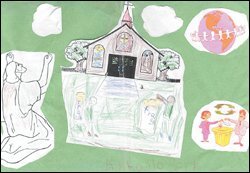
Antonio Peck's poster on the environment includes Jesus and a church, along with children depositing trash. His parents' lawsuit alleged that the school censored the religious images.

At issue is a poster that Antonio Peck, who in the spring of 2000 was a kindergartner at McNamara Elementary School in the 5,900-student Baldwinsville, N.Y., school district, made at home with the help of his mother, JoAnne Peck, for an assignment on recycling. His teacher had directed her students to create posters based on a two-month environmental unit; the posters were to be displayed at a school environmental program to which parents would be invited.

The first version of Antonio’s poster featured cutout pictures of Jesus, the Ten Commandments, and other religious images under the heading “The only way to save our world!”

A substitute poster, which Antonio and his mother made after the teacher asked him to revise it to address material learned in class, showed a recycling symbol and children cleaning up trash, but also depicted Jesus and a church.

For the environmental program, school personnel hung Antonio’s poster with those by other pupils but folded it back so the part showing Jesus could not be seen. The boy’s parents sued, claiming a violation of Antonio’s First Amendment rights to free exercise of religion and free speech, and other violations.

A Religious Perspective

A federal district judge in Syracuse dismissed the suit. But in October 2005, a three-judge panel of the 2nd Circuit court unanimously found merit in the family’s free-speech claim.

“The district court overlooked evidence that, if construed in the light most favorable to the Pecks, suggested that Antonio’s poster was censored not because it was unresponsive to the assignment, and not because [the teacher and school principal] believe that JoAnne Peck rather than Antonio was responsible for the poster’s content, but because it offered a religious perspective on the topic of how to save the environment,” U.S. Circuit Judge Guido Calabresi wrote.

Distinguishing a student’s expression of a “religious viewpoint,” which may be constitutionally protected speech, from a student’s unprotected “religious proselytizing,” can be hard, the judge said.

But whether Antonio’s poster showed a “religious viewpoint,” and whether the school would have similarly censored a poster that depicted a purely secular image that was equally outside the scope of the lessons, were disputed factual questions that should be resolved in a trial, Judge Calabresi wrote.

In its petition to the Supreme Court, the Baldwinsville district argued that the appeals court’s decision “perilously tied the hands of public school educators within its jurisdiction.”

The Supreme Court on April 24 declined without comment to hear the district’s appeal in Baldwinsville School District v. Peck (Case No. 05-899). The case will now return to the district court for further proceedings.

A version of this article appeared in the May 03, 2006 edition of Education Week as High Court Declines to Hear Case On Pupil’s Use of Religious Images

Events

Jobs Regional K-12 Virtual Career Fair: DMV
Find teaching jobs and K-12 education jubs at the EdWeek Top School Jobs virtual career fair.
This content is provided by our sponsor. It is not written by and does not necessarily reflect the views of Education Week's editorial staff.
Sponsor
Artificial Intelligence Webinar
Making AI Work in Schools: From Experimentation to Purposeful Practice
AI use is expanding in schools. Learn how district leaders can move from experimentation to coordinated, systemwide impact.
Content provided by Frontline Education
This content is provided by our sponsor. It is not written by and does not necessarily reflect the views of Education Week's editorial staff.
Sponsor
Student Well-Being & Movement Webinar
Building Resilient Students: Leadership Beyond the Classroom
How can schools build resilient, confident students? Join education leaders to explore new strategies for leadership and well-being.
Content provided by IMG Academy

EdWeek Top School Jobs

Teacher Jobs
Search over ten thousand teaching jobs nationwide — elementary, middle, high school and more.
View Jobs
Principal Jobs
Find hundreds of jobs for principals, assistant principals, and other school leadership roles.
View Jobs
Administrator Jobs
Over a thousand district-level jobs: superintendents, directors, more.
View Jobs
Support Staff Jobs
Search thousands of jobs, from paraprofessionals to counselors and more.
View Jobs

Read Next

Law & Courts Supreme Court to Consider Whether Catholic Preschools Can Reject LGBTQ+ Families
Catholic preschools say Colorado violated religious rights by excluding them from a state-funded program over admission policies.
2 min read
Image of the Supreme Court in the background, an LGBTQ flag waving, and symbols of wedding rings with a male and female sign incorporated in the ring shapes.
Laura Baker/Education Week + Canva
Law & Courts Opinion Why the Supreme Court’s Ruling on Conversion Therapy Matters for Schools
A recent case puts religiously motivated speech ahead of the well-being of LGBTQ+ youth.
Jonathon E. Sawyer
5 min read
lgbtq student backpack with rainbow spectrum flag on stairs isolated
Education Week + iStock/Getty
Law & Courts Minn. Districts Ask Judge to Restore Immigration Enforcement Limits by Schools
Two districts say the policy change hurt attendance and cost them students.
3 min read
Fridley Superintendent Brenda Lewis speaks during a news conference in February at the Minnesota State Capitol.
Superintendent Brenda Lewis of the Fridley, Minn., school district speaks during a news conference in February 2026 at the Minnesota State Capitol. The Fridley district is one of two Minnesota school districts suing the U.S. Department of Homeland Security in an effort to restore restrictions on immigration enforcement in and near schools.
Carlos Gonzalez/Minnesota Star Tribune via TNS
Law & Courts Birthright Citizenship Case Raises Stakes for Schools and Undocumented Students
Educators are paying close attention to the case on Trump's birthright citizenship order.
10 min read
President Donald Trump signs an executive order on birthright citizenship in the Oval Office of the White House in Washington, Jan. 20, 2025.
President Donald Trump signs an executive order on birthright citizenship in the Oval Office of the White House on Jan. 20, 2025. The order, now before the U.S. Supreme Court, seeks to limit citizenship for some children born in the United States to immigrant parents without permanent legal status.
Evan Vucci/AP
