Law & Courts

Court Strengthens Protections for Districts From Civil Rights Suits

By Mark Walsh — May 07, 1997 3 min read
  • Save to favorites
  • Print

A divided U.S. Supreme Court last week gave school districts and other local governments stronger protection against lawsuits alleging that their employees committed civil rights violations.

In a case involving alleged police brutality by an Oklahoma sheriff’s deputy, the high court placed new limits on a Reconstruction-era civil rights law that is often cited by plaintiffs who sue districts in federal court.

The court ruled 5-4 on April 28 in Board of County Commissioners of Bryan County v. Brown (Case No. 95-1100) that local governments cannot be held liable for civil rights violations of their employees merely because in a single hiring decision they failed to adequately consider an employee’s checkered background.

The Oklahoma case was brought by a woman whose knees were seriously injured when she was thrown to the ground by a sheriff’s deputy during a traffic stop. A federal court found Bryan County, Okla., partially liable for a violation of the woman’s civil rights because the local sheriff had hired the deputy despite knowing about the man’s misdemeanor-arrest record for assault and battery.

The woman won more than $800,000 in damages and lawyer’s fees from the deputy and the county, an award that was largely upheld by the U.S. Court of Appeals for the 5th Circuit.

The woman’s lawsuit was brought under the Civil Rights Act of 1871, which allows suits for damages when government authority is used to deny a person’s federal constitutional or statutory rights.

The statute, usually referred to as Section 1983 for its place in the federal code, is most often cited in police-brutality cases. But it has increasingly been the basis for lawsuits seeking to hold districts liable for actions by teachers and other employees, such as sexual abuse or failure to protect children from dangers in school.

‘Deliberate Indifference’

In a 1978 decision, Monell v. New York City Department of Social Services, the Supreme Court removed local governments’ complete immunity from suits under Section 1983.

The court ruled that cities, counties, and school boards could not be held liable merely because they employed someone who violated a person’s civil rights. But local governments could be held liable if the deprivation of rights could be tied to an official policy or custom of the government.

Thus, many plaintiffs who sue districts under Section 1983 seek to establish that a district policy or custom led to a rights violation. Most such suits already face an uphill battle in court, but the Supreme Court’s decision last week should bolster districts’ defenses, legal experts said.

“From the employers’ standpoint, it seems the court does not want to make every hiring decision a constitutional issue,” said David R. Friedman, a Madison, Wis., lawyer who represents school boards and has written about district liability under Section 1983.

Writing for the high court’s majority, Justice Sandra Day O’Connor said there must be a strong connection between a local government’s hiring decision and the possibility that the employee will commit constitutional violations.

The sheriff’s inadequate scrutiny of the deputy’s criminal record does not meet the court’s test that a local government show “deliberate indifference” to the possibility of constitutional violations, she said.

“Congress did not intend municipalities to be held liable [under Section 1983] unless deliberate action attributable to the municipality directly caused a violation of federal rights,” Justice O’Connor wrote. Her opinion was joined by Chief Justice William H. Rehnquist and Justices Antonin Scalia, Anthony M. Kennedy, and Clarence Thomas.

Justices John Paul Stevens, David H. Souter, Ruth Bader Ginsburg, and Stephen G. Breyer dissented.

Justice Breyer, in a dissent joined by Justices Stevens and Ginsburg, said the high court’s rulings on Section 1983 are confusing, and he called for a reconsideration of the 1978 Monell decision.

The “complexity” of rulings about Section 1983 “makes it difficult for municipalities to predict just when they will be held liable based upon policy or custom,” Justice Breyer said.

Related Tags:

Events

This content is provided by our sponsor. It is not written by and does not necessarily reflect the views of Education Week's editorial staff.
Sponsor
Artificial Intelligence Webinar
Managing AI in Schools: Practical Strategies for Districts
How should districts govern AI in schools? Learn practical strategies for policies, safety, transparency, as well as responsible adoption.
Content provided by Lightspeed Systems
This content is provided by our sponsor. It is not written by and does not necessarily reflect the views of Education Week's editorial staff.
Sponsor
Reading & Literacy Webinar
Unlocking Success for Struggling Adolescent Readers
The Science of Reading transformed K-3 literacy. Now it's time to extend that focus to students in grades 6 through 12.
Content provided by STARI
Jobs Virtual Career Fair for Teachers and K-12 Staff
Find teaching jobs and K-12 education jubs at the EdWeek Top School Jobs virtual career fair.

EdWeek Top School Jobs

Teacher Jobs
Search over ten thousand teaching jobs nationwide — elementary, middle, high school and more.
View Jobs
Principal Jobs
Find hundreds of jobs for principals, assistant principals, and other school leadership roles.
View Jobs
Administrator Jobs
Over a thousand district-level jobs: superintendents, directors, more.
View Jobs
Support Staff Jobs
Search thousands of jobs, from paraprofessionals to counselors and more.
View Jobs

Read Next

Law & Courts Appeals Court Halts Ruling Letting Teachers Disclose Students' Gender Identity
A federal appeals court has temporarily paused enforcement of the ruling but has not yet decided whether to grant a longer-term stay.
Kristen Taketa, The San Diego Union-Tribune
3 min read
Students carrying pride and transgender flags leave Great Oak High School in Temecula, Calif., on Sept. 22, 2023, after walking out of the school in protest of the Temecula school district policy requiring parents to be notified if their child identifies as transgender.
Anjali Sharif-Paul/The Orange County Register via AP
Law & Courts Schools Can’t Bar Teachers From Telling Parents If Kids Are Transgender, Judge Rules
The injunction bans any public school employee from misleading parents about their child’s gender presentation at school.
Kristen Taketa, The San Diego Union-Tribune
5 min read
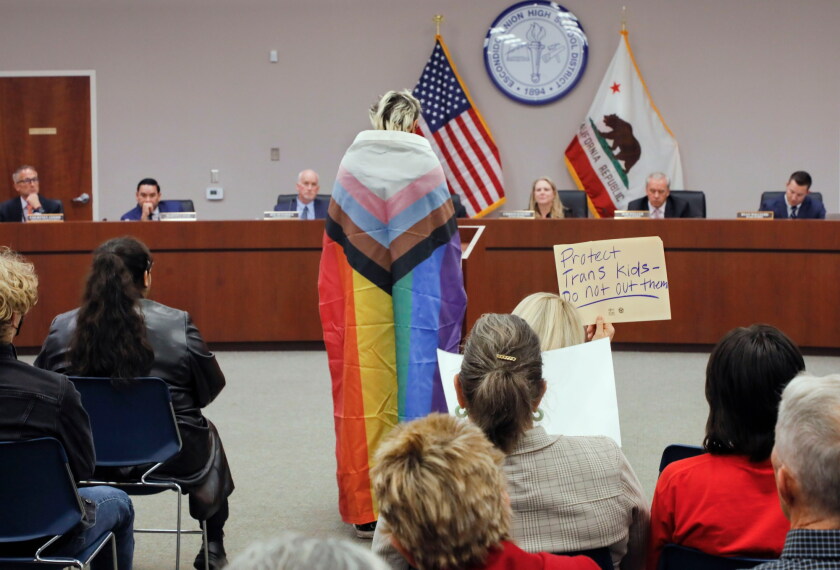
Teacher’s aide Amelia Mester, wrapped in a Pride flag, urges Escondido Union High School District not to have employees notify parents if they believe a student may be transgender in November 2025. A policy on the issue in the city’s elementary school district is the subject of a federal class-action lawsuit in which a judge just sided against the district.
Teacher’s aide Amelia Mester, wrapped in a Pride flag, urges Escondido Union High School District not to have employees notify parents if they believe a student may be transgender. A policy on the issue in the city’s elementary school district is the subject of a federal class-action lawsuit in which a judge just ruled against the district.
Charlie Neuman for The San Diego Union-Tribune/TNS
Law & Courts Federal Appeals Court Upholds 8th Grader's Expulsion Over Gun Comments in Class
Shortly after a nearby mass school shooting, a student allegedly discussed bringing a gun to school.
3 min read
Photo of stone columns.
E+
Law & Courts Trump's Education Policies Spurred 72 Lawsuits in 2025. How Many Is He Winning?
The legal challenges show which policies have had a big impact and how 2026 could go.
5 min read
President Donald Trump holds up an executive order after signing it at an indoor Presidential Inauguration parade event in Washington, Jan. 20, 2025.
President Donald Trump holds up an executive order after signing it at an indoor presidential inauguration parade event in Washington on Jan. 20, 2025. Trump's executive actions prompted legal challenges virtually from the moment he took office, and education-related policies were not immune.
Matt Rourke/AP
