Federal

Conn. Sees Legal Boost for Its NCLB Suit

By Mark Walsh — July 07, 2006 3 min read
  • Save to favorites
  • Print

The state of Connecticut is seizing on language in a recent U.S. Supreme Court opinion on special education, saying it bolsters the state’s challenge to the federal No Child Left Behind Act. Several independent legal experts agree, although not without some cautionary notes.

“We think it could be profoundly significant to our case,” Connecticut Attorney General Richard Blumenthal said in an interview last week, referring to the high court’s decision in Arlington Central School District v. Murphy (Case No. 05-18).

The court ruled 6-3 on June 26 that the Individuals with Disabilities Education Act does not authorize parents who win disputes with school districts over their children’s special education plans to recover the costs of experts.

In his majority opinion, Justice Samuel A. Alito Jr. said the spending power outlined in Article I of the U.S. Constitution requires Congress to give the states clear notice of their obligations under a spending-clause statute such as the IDEA.

Justice Alito noted court precedents that say federal legislation under the spending clause “is much in the nature of a contract, and therefore, to be bound by federally imposed conditions, recipients of federal funds must accept them voluntarily and knowingly.”

“States cannot knowingly accept conditions of which they are unaware or which they are unable to ascertain,” Justice Alito said. He went on to conclude that state officials would not have clearly understood when they accepted IDEA money that one of the conditions was that parents could be reimbursed for experts’ fees.

“In a spending-clause case, the key is … what the states are clearly told regarding the conditions that go along with the acceptance of [federal] funds,” Justice Alito said.

‘Adequate Notice’

Mr. Blumenthal, the Connecticut attorney general, said in the July 5 interview that state lawyers filed papers soon after the Supreme Court’s ruling to notify the federal district judge hearing the state’s challenge to the No Child Left Behind law.

“The court states very clearly that conditions attached to federal funds have to be unambiguous and provide adequate notice to the states as a requirement under the spending clause,” he said.

Connecticut contends in its suit, which is pending in the federal district court in Hartford, that the U.S. Department of Education’s refusal to fully fund the testing system it is requiring of the state or else waive the requirement violates both the spending clause and language in the NCLB law itself against unfunded mandates.

The Bush administration has sought dismissal of the state’s suit. A Department of Justice spokeswoman said last week that lawyers were reviewing the implications of the high court’s ruling.

Justice Alito’s discussion of the spending clause in the Arlington Central case caused a bit of a stir among legal commentators.

Drew S. Days III, a Washington lawyer who filed a friend-of-the-court brief in the IDEA case in support of the parents, said Justice Alito’s language suggested new life for legal arguments that some states had been offering in recent years without much success.

“I’m not sure where it’s going,” but it was notable, said Mr. Days, who was a U.S. solicitor general under President Clinton.

Thomas Hutton, a staff lawyer with the National School Boards Association, said the opinion might indeed aid Connecticut.

“I think their position is bolstered,” he said. “Clearly, the [Supreme] Court has signaled that this spending-clause argument is one that it has embraced.”

Samuel R. Bagenstos, a law professor at Washington University in St. Louis, said Justice Alito’s spending-clause discussion was potentially significant, although he wasn’t sure lower courts would rush to employ it.

“The argument that Congress needs to provide clear notice of every detail at the time a state accepts federal funds is one that is potentially very far-reaching,” said Mr. Bagenstos, who was a law clerk to Supreme Court Justice Ruth Bader Ginsburg. “This gives Connecticut another arrow in its quiver. But it’s not clear it changes the result.”
A version of this article appeared in the July 12, 2006 edition of Education Week as Conn. Sees Legal Boost for Its NCLB Suit

Events

This content is provided by our sponsor. It is not written by and does not necessarily reflect the views of Education Week's editorial staff.
Sponsor
Artificial Intelligence Webinar
Managing AI in Schools: Practical Strategies for Districts
How should districts govern AI in schools? Learn practical strategies for policies, safety, transparency, and responsible adoption.
Content provided by Lightspeed Systems
Jobs Virtual Career Fair for Teachers and K-12 Staff
Find teaching jobs and K-12 education jubs at the EdWeek Top School Jobs virtual career fair.
This content is provided by our sponsor. It is not written by and does not necessarily reflect the views of Education Week's editorial staff.
Sponsor
Student Absenteeism Webinar
Turning Attendance Data Into Family Action
This California district cut chronic absenteeism in half. Learn how they used insight and early action to reach families and change outcomes.
Content provided by SchoolStatus

EdWeek Top School Jobs

Teacher Jobs
Search over ten thousand teaching jobs nationwide — elementary, middle, high school and more.
View Jobs
Principal Jobs
Find hundreds of jobs for principals, assistant principals, and other school leadership roles.
View Jobs
Administrator Jobs
Over a thousand district-level jobs: superintendents, directors, more.
View Jobs
Support Staff Jobs
Search thousands of jobs, from paraprofessionals to counselors and more.
View Jobs

Read Next

Federal Trump Talks Up AI in State of the Union, But Not Much Else About Education
The president didn't mention two of his cornerstone education policies from the past year.
4 min read
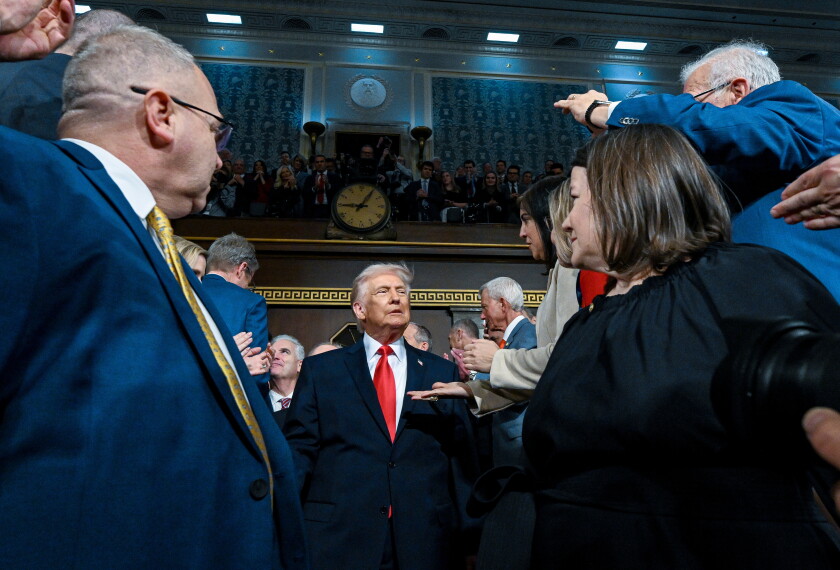
President Donald Trump enters to deliver the State of the Union address to a joint session of Congress in the House chamber at the U.S. Capitol in Washington, Tuesday, Feb. 24, 2026.
President Donald Trump enters to deliver the State of the Union address to a joint session of Congress in the House chamber at the U.S. Capitol in Washington, Tuesday, Feb. 24, 2026. The president devoted little time in the speech to discussing his education policies.
Kenny Holston/The New York Times via AP, Pool
Federal Education Department Will Send More of Its Programs to Other Agencies
Education grants for school safety, community schools, and family engagement will shift to Health and Human Services.
4 min read
Various school representatives and parent liaisons attend a family and community engagement think tank discussion at Lowery Conference Center on March 13, 2024 in Denver. One of the goals of the meeting was to discuss how schools can better integrate new students and families into the district. Denver Public Schools has six community hubs across the district that have serviced 3,000 new students since October 2023. Each community hub has different resources for families and students catering to what the community needs.
A program that helps state education departments and schools improve family engagement policies is among those the Trump administration will transfer from the U.S. Department of Education to the U.S. Department of Health and Human Services. In this photo, school representatives and parent liaisons attend a family and community engagement discussion on March 13, 2024, in Denver to discuss how schools can better integrate new students and families into the district.
Rebecca Slezak For Education Week
Federal New Trump Admin. Guidance Says Teachers Can Pray With Students
The president said the guidance for public schools would ensure "total protection" for school prayer.
3 min read
MADISON, AL - MARCH 29: Bob Jones High School football players touch the people near them during a prayer after morning workouts and before the rest of the school day on March 29, 2024, in Madison, AL. Head football coach Kelvis White and his brother follow in the footsteps of their father, who was also a football coach. As sports in the United States deals with polarization, Coach White and Bob Jones High School form a classic tale of team, unity, and brotherhood. (Photo by Jahi Chikwendiu/The Washington Post via Getty Images)
Football players at Bob Jones High School in Madison, Ala., pray after morning workouts before the rest of the school day on March 29, 2024. New guidance from the U.S. Department of Education says students and educators can pray at school, as long as the prayer isn't school-sponsored and disruptive to school and classroom activities, and students aren't coerced to participate.
Jahi Chikwendiu/Washington Post via Getty Images
Federal Ed. Dept. Paid Civil Rights Staffers Up to $38 Million as It Tried to Lay Them Off
A report from Congress' watchdog looks into the Trump Admin.'s efforts to downsize the Education Department.
5 min read
Commuters walk past the headquarters of the U.S. Department of Eduction, which were ordered closed for the day for what officials described as security reasons amid large-scale layoffs, on March 12, 2025, in Washington.
The U.S. Department of Education spent up to $38 million last year to pay civil rights staffers who remained on administrative leave while the agency tried to lay them off.
Mark Schiefelbein/AP
