Includes updates and/or revisions.
Describing the dwindling number of faith-based schools in U.S. cities as a “crisis,” President Bush last week called for efforts from government at all levels, as well as corporations and private citizens, to help change the situation.
Such inner-city schools are closing at an “alarming rate,” the president said at a conference on the topic. He noted that between 2000 and 2006, 1,200 religious schools in American cities have shut down, displacing some 400,000 students.
“We have an interest in the health of these centers of excellence,” he said. “It’s in the country’s interest to get beyond the debate over public-private, to recognize that this is a critical national asset.”
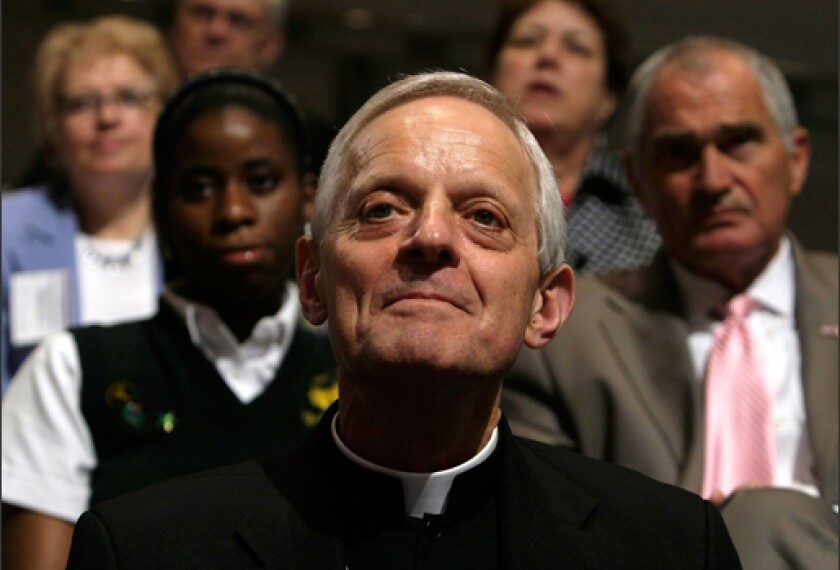
The daylong White House Summit on Inner-City Children and Faith-Based Schools brought together a variety of academics, leaders from private schools, and advocates for religious schools, as well as federal and state officials.
The event last week followed Pope Benedict XVI’s April 15-20 visit to the United States. As part of that trip, the Roman Catholic pontiff addressed education leaders at the Catholic University of America, in Washington, where he urged steps to ensure the long-term sustainability of U.S. parochial schools.
At the summit, Mr. Bush promoted his recent “Pell Grants for Kids” proposal, which he unveiled in his State of the Union address. The plan would provide $300 million to award grants on a competitive basis to states, school districts, cities, and nonprofit organizations to create scholarship programs for low-income students in schools that have missed their achievement targets under the federal No Child Left Behind Act, and in high schools in which graduation rates are lower than 60 percent.
Democrats in Congress, who hold majorities in both chambers, have been sharply critical of Mr. Bush’s proposal.
President Bush last week also trumpeted the voucher program for the District of Columbia, which has provided federally funded tuition vouchers for private schooling to students from low-income families since 2004. He pledged to work with Congress to not only reauthorize the voucher program, “but hopefully expand it.”
‘Go Beyond That’
However, David Zwiebel, the general counsel and an executive vice president at Agudath Israel of America, a national Orthodox Jewish nonprofit organization based in New York City, said during a panel at the conference that the Bush plan was too limited because it tied the choice option to students in a particular set of schools.
“With all due respect,” he said, “we ought to go beyond that.”
Many public education advocates have criticized the federal voucher program, arguing that it diverts money needed by public schools.
Meanwhile, Mr. Bush urged states to remove so-called Blaine Amendments, which are clauses in state constitutions that restrict the flow of public money to religious schools. And he highlighted other examples he finds encouraging, such as Pennsylvania’s Educational Improvement Tax Credit Program, which provides state tax credits to businesses that donate to organizations that provide scholarships or work for “educational improvement.”
In a morning session, panelist Charles L. Glenn argued that the federal government’s stance toward private schools is out of step with the international community.
“Every Western democracy besides the United States provides public funding to support those choices,” said Mr. Glenn, the interim dean of Boston University’s school of education.
The president also highlighted the Jubilee Schools initiative in Memphis, Tenn., which was launched with $15 million in seed money from private donors and has reopened closed Roman Catholic parochial schools.
Later in the day, Mary C. McDonald, the superintendent of Catholic schools for the Diocese of Memphis, called the Jubilee schools “community treasures” that “have done much to bridge racial divides.”
Ms. McDonald said test data and other indicators suggest the students are thriving in the schools. For instance, she said the graduation rate is 99.5 percent.
“They are beating the odds,” she said of the students, nearly all of whom come from families with incomes at or below the poverty level. “Their universe is changing.”
Notre Dame Efforts
The University of Notre Dame, in Indiana, has become increasingly involved in efforts to help urban Catholic schools, said the Rev. Timothy R. Scully, the director of the university’s institute for educational initiatives.
For one, it has developed the Alliance for Catholic Education, which trains and provides 180 teachers and nearly 100 principals every year to high-need Catholic schools in cities across the country.
In addition, the university has formed a partnership with 15 other Catholic colleges and universities to help develop teachers and leaders to face the specific challenges of urban Catholic schools, Father Scully said.
The university also has a pilot effort to partner with three struggling diocesan schools in Chicago, South Bend, Ind., and Washington.
Father Scully said the university is starting a center for research on faith-based schools as well. He urged other higher education institutions to support such scholarship.
“The crisis we currently face is ultimately a crisis of imagination and will,” he said.
“We know the gloomy trends,” Father Scully added. “But let’s not get so used to the darkness that we fail to see the light.”


