
The Centers for Disease Control and Prevention are reconsidering social distancing guidelines for schools with universal mask wearing, in response to new research suggesting that spacing students 3 feet apart may be sufficient to ward off outbreaks of COVID-19 when all other safety measures are followed.
If the agency decides less distancing is still safe, it could save schools on space and staffing costs and reduce the number of students held in quarantine.
CDC guidance for school reopening issued in February maintains the agency’s stance that students and staff must stay at least 6 feet apart from one another to avoid risk of contagion from airborne droplets or aerosolized coronavirus particles when people talk, cough, or sneeze. Students or staff who come within 6 feet of someone who tests positive for COVID-19 for a total of 15 minutes or more within the space of 24 hours also are recommended to be quarantined.
Critics have argued the guidance makes it much harder to physically house students for in-person classes—no state’s building codes call for classrooms large enough to handle that kind of spacing. They say the guidance pushes more people than necessary into 10- to 14-day quarantine periods in which they could only learn or teach remotely.
“As soon as we put out the guidance, among the biggest challenges that we were aware of was the fact that schools were having problems with the 6-foot guidance, and that, of course, prompted more studies to say, is 6 feet necessary in the context of mask-wearing,” said Rochelle Walensky, CDC director, in a press briefing by the White House COVID-19 Response Team on Monday.
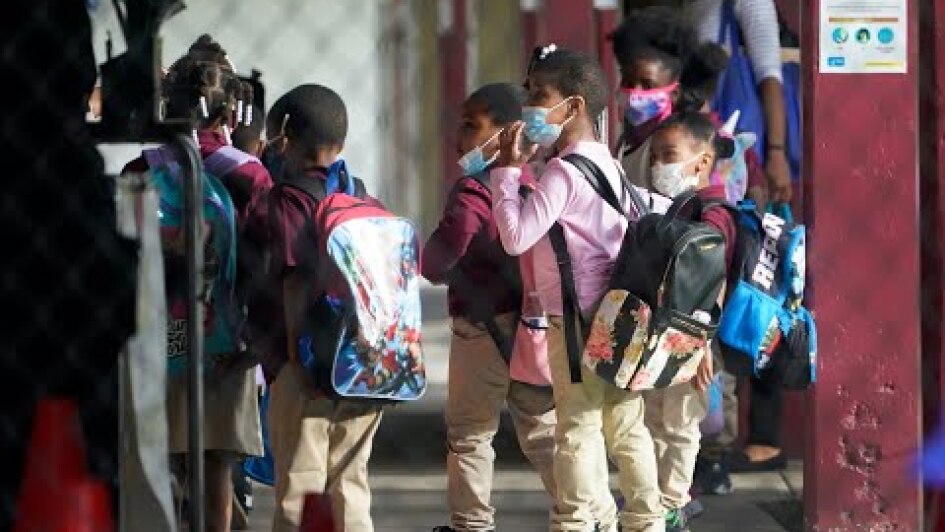
The World Health Organization already recommends smaller physical distancing of 1 meter, or 3.3 feet, but there has been limited research on how much of a difference it makes in infection risk to separate students by 6 feet versus 3 feet. There have been studies finding both benefits of distancing by 6 feet or more and risks from separating less than 3 feet, but the safety of distancing between 3 and 6 feet was murky.
A study of Massachusetts schools released online last week, ahead of the print edition of the journal Clinical Infectious Diseases, suggests schools can use smaller distances safely—if they strictly follow other pandemic mitigation measures, such as universal mask-wearing. Researchers tracked well over 500,000 students and nearly 100,000 staff at 251 school districts in Massachussetts over a 16-week period. They found that among the schools where 100 percent of students and adults wore masks, the infection rates were no higher on campuses that used 3-foot distancing than in those using 6-foot distancing.
Walensky noted that the Massachusetts study has prompted the CDC to launch additional research on social distancing in environments with universal mask wearing. “We’re taking a look at all of those data carefully and revisiting the guidance in that context,” she said.
Costs of Distancing Weigh on Schools
Figuring out the right approach to distancing isn’t just a matter of adhering to public health guidelines. Finances and logistics inevitably play a major role, as schools with finite resources grapple with the unforeseen costs of operating during the pandemic.
Schools could use some portion of the federal stimulus funds from the American Rescue Plan aid package for “school facility repairs and improvements to enable operation of schools to reduce risk of virus transmission and exposure to environmental health hazards,” according to the bill text. But it’s unclear where school districts will rank that priority among many others, including addressing learning loss and providing summer school options.
Jonathan Travers, a partner at the consulting firm Education Resource Strategies, has been working with school districts to analyze their physical spaces and determine the feasibility of reopening in-person instruction. One district has determined that reopening school buildings to all students while maintaining 6-foot distancing requirements would require as much as a 30 percent increase in classroom space and staffing.
Given that the school year is winding down in many places, an effort on that scale is “essentially a non-starter in the short term,” Travers said.
That district found that 3-foot distancing, on the other hand, would be doable in the majority of its buildings without major changes to the number of students in a class group. Even there, though, some classrooms simply wouldn’t accommodate an adequate number of students.
“As your sizes get into the 20s, the specifics of room layout, furniture placement, configuration of space begin to matter a lot more,” Travers said.
The costs could break down in several ways. With either approach to social distancing, most classrooms would have to have fewer students than usual, which means schools would need more teachers. Gymnasiums and auditoriums could double as classrooms, or a partnership with a local business could provide more space for students and staff outside the school building. Some of those arrangements, too, could be prohibitively expensive.
As budgeting season ramps up, many schools are already looking ahead to put in place massive summer school and tutoring initiatives. Federal stimulus funds on the way will more likely go towards those needs.
“A lot of places are not looking to do complete overhauls of the system at this point,” said Michael Griffith, a senior researcher and policy analyst at the Learning Policy Institute.
Still, as political pressure for in-person instruction ramps up, districts are eager to gain as much clarity as possible on what’s acceptable so they can quickly determine what’s possible.
“The sooner we know, the more runway we have to be creative and thoughtful in our planning,” Travers said.




