School Choice & Charters Photo Essay

Nurturing Success at a Los Angeles Charter School

By Education Week Photo Staff — June 28, 2016 2 min read
  • Save to favorites
  • Print

Photographer Patrick Fallon writes about his experiences photographing a charter school in Los Angeles, and how it contrasts with the high school he attended.
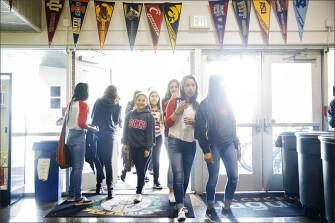
Students arrive for classes at Alliance Collins Family College-Ready High School, a public charter school in Huntington Park, Calif.

On my recent assignment for Education Week that chronicled the 25th anniversary of the charter schools movement, I couldn’t help but think of some of the major contrasts of my own large public high school experience and that of the students at Alliance Collins Family College-Ready High School.

The high school that I graduated from in 2007 – Redondo Union High School in Redondo Beach, Calif. – is a massive beast of a campus. It’s the second-largest in area in California at 56 acres—with over 2,700 students. By comparison, the Alliance charter school that I visited has a population of less than a quarter of that and operates inside a shuttered shoe factory in an industrial part of the Los Angeles area. The downtown skyline looms on the northern horizon.

Just a few miles north of the Alliance Collins Family College-Ready High School, the skyline of downtown Los Angeles stands at sunset as seen from a bridge overlooking the Los Angeles River.

The 100-year-old Redondo campus has views of the Pacific Ocean. It was there where I started working with photography on the school’s yearbook and newspaper staffs, and realized that photographing people and news events could be my job. Friday nights in the fall were spent covering football games and talking to newspaper photographers – some of whom I now work alongside covering events for competing publications.

While some skylights in the campus at Alliance Collins funneled natural light into the hallways, I felt a little starved for natural light and windows as I walked around the school. Going outside for science experiments or meal breaks proved to be a welcome reprieve. Every so often, freight trains rumbled and roared from the tracks that run parallel to the school.

But the lack of natural light and noisy interruptions didn’t detract from the strong intimacy I observed among the students, staff and administrators. While I never felt “lost” at Redondo High, I could easily see how other students there might feel that way. The closer environment of Alliance Collins helps keep everyone connected, focused and more accountable.


Student Krystal Lopez completes a class assignment about Freedom Riders in a U.S. history class at Alliance Collins.
Alberto Esparza and Valerie Flores, right, prepare a lab experiment with teacher Matt Duda, left, during chemistry class.
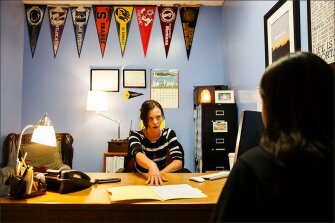
Counselor Lani E. Advokat discusses the college application process with junior Susana Delgadillo.
A poster pays tribute to parents who have become actively involved in their child’s education at Alliance Collins. The school serves mostly low-income, Latino students.

I was most impressed by the high college acceptance rate of the 2016 class at Alliance Collins: Every graduating student was accepted into a 4-year university. There was no shortage of posters and banners supporting students in this quest – a visual representation of how the school creates an environment and an expectation that students will go onto, and be ready for college.

It was this very explicit expectation for success that tied both schools together for me. With the right environment and resources, hopefully the future of all students can be shaped to grow positively in high school and enable them to explore their individual talents.

Related Tags:

A version of this article first appeared in the Full Frame blog.

Events

This content is provided by our sponsor. It is not written by and does not necessarily reflect the views of Education Week's editorial staff.
Sponsor
College & Workforce Readiness Webinar
From Student Trends to Counselor Action: Turning Insight Into Impact
Find out what is changing in how students approach planning for life after graduation and how schools can help.
Content provided by PowerSchool
This content is provided by our sponsor. It is not written by and does not necessarily reflect the views of Education Week's editorial staff.
Sponsor
School & District Management Webinar
McKinney-Vento Transportation Strategies: Managing Cost & Protecting Access
Explore McKinney-Vento transportation strategies to manage costs, respond quickly to changing needs, and protect student access.
Content provided by HopSkipDrive
This content is provided by our sponsor. It is not written by and does not necessarily reflect the views of Education Week's editorial staff.
Sponsor
Families & the Community Webinar
Celebrate Family Engagement Day With Strategies That Work
Join National PTA and AASA to explore practical systems-wide family engagement strategies in celebration of National Family Engagement Day.

EdWeek Top School Jobs

Teacher Jobs
Search over ten thousand teaching jobs nationwide — elementary, middle, high school and more.
View Jobs
Principal Jobs
Find hundreds of jobs for principals, assistant principals, and other school leadership roles.
View Jobs
Administrator Jobs
Over a thousand district-level jobs: superintendents, directors, more.
View Jobs
Support Staff Jobs
Search thousands of jobs, from paraprofessionals to counselors and more.
View Jobs

Read Next

School Choice & Charters IRS Will Go ‘As Broad As We Can’ With Federal K-12 Choice Rules
Federal regulators want K-12 students to spend tax-credit scholarship funds on “a large range of educational needs."
3 min read
The exterior of the Internal Revenue Service (IRS) building in Washington, is photographed March 22, 2013.
The exterior of the Internal Revenue Service (IRS) building in Washington on March 22, 2013. An IRS official on Thursday said forthcoming guidance on federally backed K-12 scholarships will outline how they can cover "a large range of educational needs."
Susan Walsh/AP
School Choice & Charters After Elections, Democrats Will Run School Choice Programs They've Blasted
Democrats have criticized school choice for a long time. Now, they'll be in charge of some big programs.
6 min read
Democratic Texas gubernatorial candidate Gina Hinojosa speaks to supporters at an election night event in Austin, Texas, Tuesday, Nov. 3, 2026.
Texas Gov.-Elect Gina Hinojosa speaks to supporters at an election night event in Austin, Texas, Tuesday, Nov. 3, 2026. The Democrat pledged to repeal her state's private school choice program while on the campaign trail.
Ashley Landis/AP
School Choice & Charters A Public School District Wants to Maximize Federal Choice Funds. Here's How
Indiana's largest district is laying the groundwork for big investments through the new federal tax credit program.
6 min read
Image of a funnel with money slices flowing through onto student desks
Collage by Laura Baker/Education Week + Getty
School Choice & Charters Public Schools Are Prepping for Federal Choice Cash. They Still Might Not Get It
Educators in states that haven't opted into the new federal program are preparing for their students to benefit.
6 min read
A photo collage of a 4 pane window on top of a ghosted road map. Each window pane shows a different scene. Clockwise from left: mother holding the hand of her young child as they cross a cross walk toward a school building, middle school boy working a tutor, back of school bus on a rural road, and the back of a young girl working with objects.
Collage by Gina Tomko/Education Week + Canva