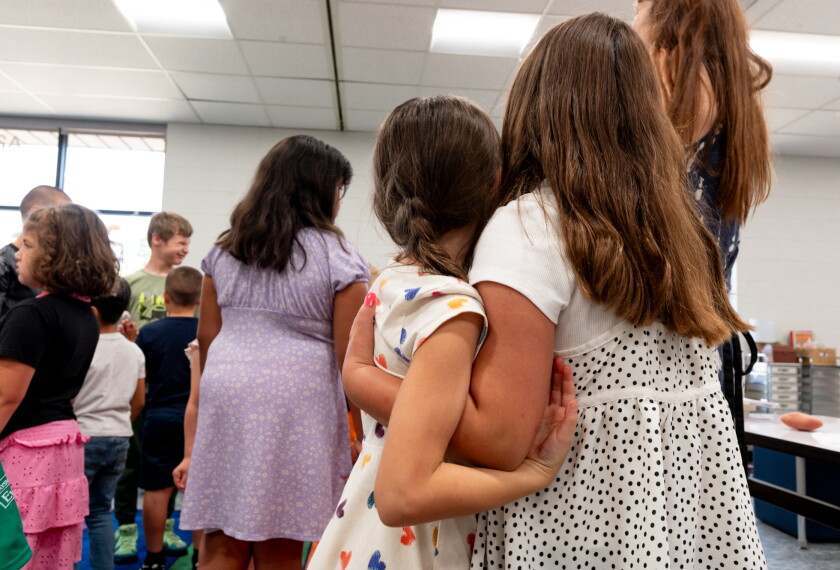
When Principal Monica D. Evans led a morning gathering on the first day of school recently, she left out what was once a central ingredient: an opening prayer.
So began the former Holy Name School’s new incarnation as the Trinidad Campus of Center City Public Charter Schools. The reinvented elementary school here in the nation’s capital has given up its Roman Catholic identity this academic year to become a charter school.
“It was a little sad to say goodbye to what we knew as Catholic education,” said Ms. Evans, adding that the switch was far preferable to seeing her school close. “But we didn’t dwell on it. It was what it was, and we were given this wonderful opportunity.”
Ms. Evans’ school is one of seven former Catholic schools across the District of Columbia that were approved in mid-June to become charters. Analysts say they are aware of no other instance in which Catholic officials have sought to convert a batch of parochial schools into public charters.
The newly formed nonprofit organization that runs them, Center City Public Charter Schools, was handpicked by the Roman Catholic Archdiocese of Washington. It was one of several organizations church leaders considered to manage the campuses.
With the switch to charter status for the schools, the archdiocese has relinquished its role in operating them. It is now simply a landlord for the buildings.
Financial Strains
The archdiocese first announced last fall that it was considering a move to convert eight schools to charters. Church officials said that the idea was being weighed with regret, but that the other alternative was to shut the schools down, given the mounting financial drain they posed. Rising costs, declining enrollments, and tuition levels that fell far short of actual expenses helped drive the decision, the archdiocese said. (“D.C. Parochial Schools May Become Charters,” Sept. 19, 2007.)
The plans sparked objections from some families, and one of the eight schools ultimately decided to remain a Catholic school.
School officials emphasize that much remains the same at the seven campuses, from a strong academic program and focus on promoting character education to many of the faculty members and school leaders.
At the Trinidad Campus in Northeast Washington, not only has Ms. Evans returned as principal, but all of the full-time classroom teachers from last year opted to come back as well, she said.
Ms. Evans herself attended the school as a student, and later taught at it before eventually becoming its principal. She said that as a public charter school, it now can serve many neighborhood families that previously couldn’t afford the $4,500 tuition. And on the opening day, Ms. Evans said she was struck by the strong turnout.
“It’s been a long time since we’ve seen that many students in the schoolyard,” she said of the roughly 210 students who showed up Sept. 2 at the pre-K-8 campus. Last year, the enrollment was about 170. Full capacity is approximately 245 students.
Across all seven new charter campuses, school officials estimate that about 1,300 students arrived for the first day, up from about 1,150 enrolled as of last December when they were Catholic schools. The new figures also could climb in coming weeks.
And while detailed demographic data were not yet available, the charters are projected to serve almost all minority students, with about 70 percent eligible for a free or reduced-price lunch.
Ms. Evans said “a little less than half” the students were returning from the prior year. School officials estimated that about 35 percent of students last year in the seven former Catholic schools lived in Maryland, and said that most of them would not be returning. Out-of-district students are permitted to enroll, but they must pay tuition.
Also, the archdiocese estimated that about four in 10 students at the schools when they were still Catholic last year received tuition vouchers under a federally funded program that provides aid to low-income families to attend secular or religious private schools in Washington.
‘Everyone Can Come’
Tyrone Calliham, a longtime resident of the city’s Trinidad neighborhood who lives blocks from the school, is among the parents enrolling children there for the first time.
“I knew their expectations for children were much higher than in D.C. public schools, so I always wanted to come here,” he said of the school. “But now they’ve made it so everyone can come.”
Mary Anne Stanton, the executive director of Center City Public Charter Schools, said the schools have long-standing local ties.
“They’re rooted in all of these communities,” she said. Many had been operating for decades. The Trinidad school, whose former name is still etched into the edifice above the double doors out front, was founded in 1924.
Ms. Stanton, who came out of retirement to lead the charter network, is no stranger to this school, or the six other campuses. A former longtime Catholic educator, she oversaw the schools in their previous iteration for eight years as the executive director of the archdiocese’s Center City Consortium, formed in 1997 as a way to revitalize and support a set of inner-city Catholic schools and provide greater support. Four of those schools remain open as Catholic schools as part of the archdiocese’s renamed Consortium of Catholic Academies.
At the Trinidad Campus’ morning gathering, Ms. Evans made clear the emphasis on developing students’ character, as she recited and asked students to repeat the school’s honor code. The “value for the month,” she then told students, was “respect.”
“Each day,” she said, “we will focus on how respect is a very important part of your everyday life.”
‘The Start of Something’?
As public schools, the campuses must administer the standardized tests taken by students in the city’s district-run schools. Yet school leaders say the curriculum is largely unchanged at the school—except for the elimination of a daily religion class.
Thomas A. Nida, the chairman of the District of Columbia Public Charter School Board, said he was impressed by the application from the charter group for the seven schools. “They just simply had an excellent application,” he said. “It covered all the bases we were looking for, and then some.”
The conversion effort faced resistance from some city council members and others worried about the costs to city coffers of adding more public schools.
“I wish that we had just been able to invite all of those children into the existing set of [public] schools, and not take on the responsibility of financing so many new schools,” said Margot Berkey, the director of a local advocacy group, Parents United for the D.C. Public Schools.
Mr. Nida said leaving aside federal dollars, the schools are eligible for roughly $11,500 per student in public funds, including the base funding for public charters, plus $3,000 per pupil for a facilities allotment.
By contrast, archdiocesan officials estimated per-pupil spending for the schools at about $7,500 last academic year.
Teachers, on average, will receive higher pay in the converted charters than they did last year, up to 22 percent more with a performance bonus, school officials say, though they did not provide actual salary figures.
Mr. Nida said he’s been hearing from Catholic officials around the country who are keenly interested in the conversion effort, given that many urban Catholic schools have closed in recent years. (“Papal Visit Spurs Plea for ‘Saving’ Catholic Schools,” April 16, 2008.)
“I know they’re watching it,” he said. “It may be the start of something you see popping up in due course elsewhere.”
Parent Nisha Long said the verdict is still out for her on whether the decision to convert the Trinidad school to charter status was a good idea. She was disappointed about taking religion out of the school, but decided to again enroll her two sons. “I was kind of skeptical in the beginning,” she said. “We’ll try it for a year and see what happens.”
The familiar faces on campus were a big selling point. “We love the teachers and the whole family atmosphere,” Ms. Long said. “They didn’t change the teachers, so that’s why we’re back.”