Blast From the Past: Ex-Ed Dept. Official Has Convention Role
A close observer of the Republican National Convention with an interest in education policy and a long memory might have recognized a familiar name from the administration of former President George H.W. Bush.
Michael L. Williams, a delegate and state officeholder from Texas, served as an assistant secretary of the convention, and he had a role in introducing the current President Bush on Sept. 2.
During the earlier Bush administration, Mr. Williams served as the assistant secretary for civil rights in the Department of Education. He drew attention for his role in a major flap over race-based scholarships that quickly reached the White House. Mr. Williams is one of several black conservatives who have held the Education Department’s civil rights post during Republican administrations. U.S. Supreme Court Justice Clarence Thomas, for instance, held the job briefly during President Ronald Reagan’s first term.
Mr. Williams is now an elected member of the Railroad Commission of Texas, a three-member panel that was established during the 19th century but remains powerful because it regulates the oil and gas industries in the Lone Star State.
Reached by phone during the convention, Mr. Williams said he was excited to be in New York City.
“The president is a friend of mine, and he’s been a friend for a quarter-century,” he said. Mr. Williams said he first met George W. Bush years ago in the president’s hometown of Midland.
As one of the assistant secretaries of the convention, Mr. Williams’ tasks included helping preside over the “Rolling Roll Call of the States,” the largely ceremonial recognition of the state delegations and their nomination votes.
A Texas native, Mr. Williams saw his national profile rise swiftly when he successfully prosecuted white supremacists while serving in the Department of Justice under President Reagan.
In 1990, while he was chief of the Education Department’s office for civil rights, he told officials at college football’s Fiesta Bowl that federal law would not allow them to award race-exclusive scholarships. The ensuing firestorm resulted in a hasty White House retreat from that stance.
Mr. Williams said at the time that his position was “legally correct” but “politically naive.”
Last week, Mr. Williams said the current President Bush could be proud of his administration’s record on civil rights, from its opposition to racial preferences in college admissions to its inclusion of Secretary of Education Rod Paige and other minority appointees in the Cabinet.
Mr. Williams said his work was likely to keep him in Texas, not in the nation’s capital.
“I’m thoroughly enjoying Texas,” he said. “I cannot imagine a circumstance under which I’d be coming back to Washington”
—Sean Cavanagh
Schwarzenegger Brings Aura, and Good Lighting, to School
Gov. Arnold Schwarzenegger of California and his entourage descended on Public School 129 in Harlem last week to promote his pet project of providing after-school programs for kids.
The Sept. 1 event was as staged as a Hollywood movie. The tanned action-hero-turned-politician, who was showcased in a convention speech the night before, brought his own cinema-quality lights (and a generator to run them) to the event in the school’s dingy gymnasium. He was surrounded by sitting students, each wearing a maroon school T-shirt with the words “Part of the solution” printed on the back. But since school was not in session, most of the students were “extras” who didn’t even attend PS 129.
The “Terminator” came to call attention to a favorite cause—after-school programs. It’s something he said he developed an interest in after serving on the first President Bush’s Council on Physical Fitness.
“I noticed after 3 p.m. that most schools closed their doors,” Gov. Schwarzenegger said. “Children were … floating around out there in the neighborhood with nothing to do.”
He urged students to work hard so they could get good jobs, so “you can be huge winners and make a lot of money.”
But if they make money, he said, they must find a balance of giving back to the community and helping others.
“Do we have a deal?” he asked. Few students would have been brave enough to turn him down. Afterward, Mr. Schwarzenegger ducked a passionate group of protesters outside the school who held signs that said “Mission Not Accomplished.” The protesters questioned why the governor didn’t mention that under President Bush, some after-school programs have lost federal funding.
Some called him a “girlie man” for not facing the protesters and chanted such slogans as “He’s not a hero, he’s a zero.”
Protester Greg Allen, who lives across the street from PS 129, said he was disappointed with the “Hollywood, photo-op” quality of the event.
“Schwarzenegger came here to learn about the schools in New York, but those schools are failing,” said Mr. Allen. “Is he going to get pointers from students on how to go to jail?”
“They need to call attention to the problems,” he said, “not obscure them.”
New York City Council Speaker Gifford Miller, who was also among the protesters, was even more direct: “We don’t want our city to become a fake backdrop to a Republican failed agenda.”
But the kids who came to see Gov. Schwarzenegger didn’t care much about Republicans or Democrats or politics. Sixth grader Isaiah Micknight, who goes to nearby PS 125, said the whole event was “cool.” He added that he’d seen Mr. Schwarzenegger in “Kindergarten Cop.”
“He looks younger,” Isaiah said.
—Michelle R. Davis
Paige’s Speech Not Ready for Cable News Channels
The Republicans opened their convention with a clever video takeoff on the opening credits for “Saturday Night Live.” As it turned out, some of the convention’s speakers could have been in the late-night nbc show’s original troupe: the Not Ready for Prime Time Players.
Secretary of Education Rod Paige was promoted by organizers as one of the main speakers for Aug. 31, the second night of the convention. Ken Mehlman, President Bush’s campaign manager, was on TV early in the evening gamely bringing up Mr. Paige’s name when a network host mentioned that the night’s big speakers were Gov. Arnold Schwarzenegger of California and first lady Laura Bush.
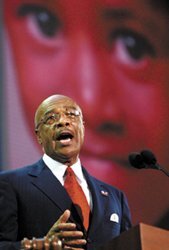
When the secretary took the stage around 9:30 p.m. Eastern time, only the Public Broadcasting Service and the C-SPAN cable channel aired his defense of the president’s record on education. The major broadcast networks were not even carrying the convention at that point, and the main cable-news channels—CNN, Fox, and MSNBC—were busy with political chat and paid no attention to Mr. Paige.
On CNN, Larry King talked with Karen Hughes, the former White House aide and now campaign adviser to President Bush, about the first lady’s upcoming speech and other topics while the education secretary spoke. On the Fox News Channel, host Sean Hannity was engaged in a heated debate with Rep. Charles B. Rangel, D-N.Y., but not about education.
PBS cut away once Mr. Paige introduced a video segment about a school described as improving because of the No Child Left Behind Act. CNN briefly tuned in a snippet of the video, but just as quickly tuned out.
Later, on Mr. King’s postconvention show, the CNN host discussed Mr. Paige’s speech for a few minutes. He asked David Gergen, the pundit and veteran adviser to presidents, whether the federal school law was working.
“It’s not working as well as it should ...,” Mr. Gergen said.
—Mark Walsh


