Law & Courts

States Can Ban Transgender Athletes, Supreme Court Decides

By The Associated Press — June 30, 2026 3 min read
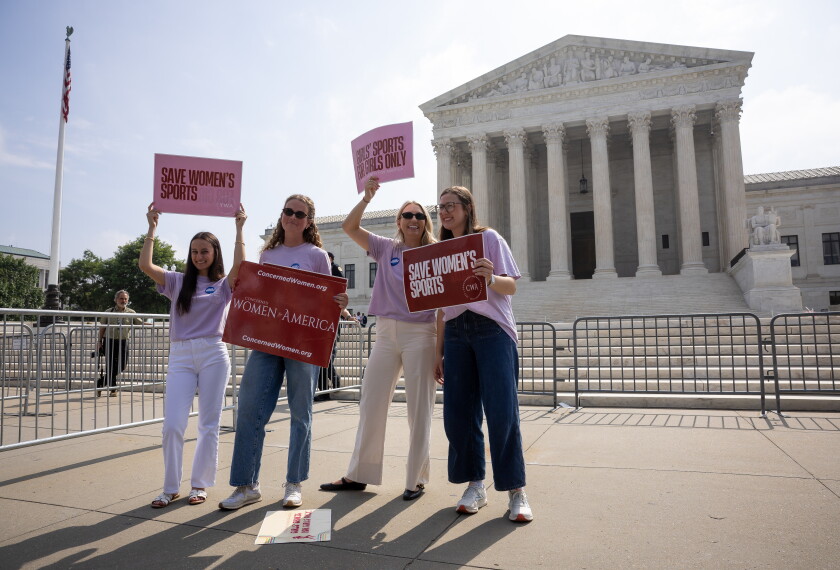
People advocate for a ban on transgender women and girls participating in women's and girls' sports outside the U.S. Supreme Court building as the court announced decisions in Washington, on June 29, 2026.
  • Save to favorites
  • Print

The Supreme Court on Tuesday upheld state laws barring transgender girls and women from playing on school athletic teams, in another setback for transgender people.

The court’s conservative majority, which has repeatedly ruled against transgender Americans in the past year, ruled that state bans in Idaho and West Virginia don’t violate the Constitution or the federal law known as Title IX, which prohibits sex discrimination in education.

More than two dozen other Republican-led states have adopted bans on female transgender athletes, and the decision seems certain to extend to them as well.

See Also

In this Nov. 21, 1979 file photo, Bella Abzug, left, and Patsy Mink of Women USA sit next to Gloria Steinem as she speaks in Washington where they warned presidential candidates that promises for women's rights will not be enough to get their support in the next election.
In this Nov. 21, 1979, photo, Bella Abzug, left, and Patsy Mink of Women USA sit next to Gloria Steinem as she speaks in Washington at an event where they warned presidential candidates that promises for women's rights will not be enough to win their support in the next election.
Harvey Georges/AP
Federal Explainer What Is Title IX? Schools, Sports, and Sex Discrimination
Libby Stanford, May 31, 2024
2 min read

Left unresolved by the outcome are lawsuits challenging state laws and regulations in Connecticut, California and elsewhere that permit transgender athletes to compete consistent with their gender identity.

Becky Pepper-Jackson, a 16-year-old high school sophomore in Bridgeport, West Virginia, has been taking puberty-blocking medication, has publicly identified as a girl since age 8 and has been issued a West Virginia birth certificate recognizing her as female. She is the only transgender person who has sought to compete in girls sports in West Virginia.

Pepper-Jackson has progressed from a back-of-the-pack cross-country runner in middle school to statewide champion in the shot put. She beat the second-place finisher by two feet in last month’s West Virginia championship meet.

In the Idaho case, Lindsay Hecox sued over the state’s first-in-the-nation ban for the chance to try out for the women’s track and cross-country teams at Boise State University in Idaho. She didn’t make either squad because “she was too slow,” her lawyer, Kathleen Hartnett, told the court during arguments in January, but she competed in club-level soccer and running.

Prominent women in sports have weighed in on both sides. Tennis champion Martina Navratilova, swimmers Summer Sanders and Donna de Varona and beach volleyball player Kerri Walsh Jennings are supporting the state bans. Soccer stars Megan Rapinoe and Becky Sauerbrunn and basketball players Sue Bird and Breanna Stewart back the transgender athletes.

In 2020, the Supreme Court ruled LGBTQ people are protected by a landmark federal civil rights law that prohibits sex discrimination in the workplace, finding that “sex plays an unmistakable role” in employers’ decisions to punish transgender people for traits and behavior they otherwise tolerate.

But last year, the six conservative justices on the nine-member court declined to apply the same sort of analysis when they upheld state bans on gender-affirming care for transgender minors.

The states supporting the prohibitions on transgender athletes argued there is no reason to extend the ruling barring workplace discrimination to Title IX.

Idaho’s law, state Solicitor General Alan Hurst said, is “necessary for fair competition because, where sports are concerned, men and women are obviously not the same.”

Lawyers for Pepper-Jackson argued that such distinctions generally make sense but that their client has none of those advantages because of the unique circumstances of her early transition. In Hecox’s case, her lawyers wanted the court to dismiss the case because she had forsworn trying to play on women’s teams.

NCAA president Charlie Baker told Congress in 2024 that he was aware of only 10 transgender athletes out of more than half a million students on college teams. But despite the small numbers, the issue has taken on outsize importance.

Baker’s NCAA and the U.S. Olympic and Paralympic Committees banned transgender women from women’s sports after President Donald Trump, a Republican, signed an executive order aimed at barring their participation.

The public generally is supportive of the limits. An Associated Press-NORC Center for Public Affairs Research poll conducted in October 2025 found that about 6 in 10 U.S. adults “strongly” or “somewhat” favored requiring transgender children and teenagers to compete only on sports teams that match the sex they were assigned at birth, not the gender they identify with, while about 2 in 10 were “strongly” or “somewhat” opposed and about one-quarter did not have an opinion.

About 2.1 million adults, or 0.8%, and 724,000 people ages 13 to 17, or 3.3%, identify as transgender in the U.S., according to the Williams Institute at the UCLA School of Law.

Related Tags:

Copyright 2026 The Associated Press. All rights reserved. This material may not be published, broadcast, rewritten or redistributed without permission.

Events

EdWeek Top School Jobs

Teacher Jobs
Search over ten thousand teaching jobs nationwide — elementary, middle, high school and more.
View Jobs
Principal Jobs
Find hundreds of jobs for principals, assistant principals, and other school leadership roles.
View Jobs
Administrator Jobs
Over a thousand district-level jobs: superintendents, directors, more.
View Jobs
Support Staff Jobs
Search thousands of jobs, from paraprofessionals to counselors and more.
View Jobs

Read Next

Law & Courts What Schools Need to Know About the Supreme Court’s Transgender Sports Ruling
The justices upheld two state laws that bar transgender girls from participating in female sports.
10 min read
A group prays outside of the Supreme Court ahead of the court's ruling on whether transgender girls and women can play on school athletic teams, on June 30, 2026, on Capitol Hill in Washington.
A group prays outside of the U.S. Supreme Court ahead of the court's ruling on whether transgender girls and women can play on school athletic teams, on June 30, 2026, in Washington. The court upheld two state laws barring transgender girls from joining girls' school sports teams.
Jose Luis Magana/AP
Law & Courts Judges Strike Down Trump Admin.'s Student Loan Forgiveness Overhaul
Two judges sided with advocates who said the program risked becoming a tool for political retribution.
3 min read
In this May 5, 2018, file photo, graduates at the University of Toledo commencement ceremony in Toledo, Ohio.
Graduates at the University of Toledo commencement ceremony in Toledo, Ohio, on May 5, 2018. Two judges have ruled against the Trump administration's overhaul of a public service loan forgiveness program for which teachers have qualified.
Carlos Osorio/AP
Law & Courts Supreme Court Upholds Birthright Citizenship, Rejecting Trump's Proposed Limits
The justices relied on the 14th Amendment and federal law to rule that anyone born in the U.S. is a citizen.
4 min read
Members of the Supreme Court sit for a group portrait in Washington, Oct. 7, 2022. Bottom row, from left, Justice Sonia Sotomayor, Justice Clarence Thomas, Chief Justice John Roberts, Justice Samuel Alito and Justice Elena Kagan. Top row, from left, Justice Amy Coney Barrett, Justice Neil Gorsuch, Justice Brett Kavanaugh, and Justice Ketanji Brown Jackson. The Supreme Court justices will take the bench Monday, July 1, 2024, to release their last few opinions of the term, including their most closely watched case: whether former President Donald Trump has immunity from criminal prosecution.
Members of the Supreme Court sit for a group portrait in Washington, Oct. 7, 2022. Bottom row, from left, Justice Sonia Sotomayor, Justice Clarence Thomas, Chief Justice John Roberts, Justice Samuel Alito, and Justice Elena Kagan. Top row, from left, Justice Amy Coney Barrett, Justice Neil Gorsuch, Justice Brett Kavanaugh, and Justice Ketanji Brown Jackson. The high court, on June 30, 2026, rejected President Donald Trump's executive order on birthright citizenship.
J. Scott Applewhite/AP
Law & Courts Judge Voids Trump Admin. Rule Excluding Education From ‘Professional’ Degrees
A judge ruled the agency didn't have the authority to adopt such a narrow definition.
4 min read
Graduates in the School of Education hold up books as their degrees are conferred during Harvard's 371st Commencement, on May 26, 2022, in Cambridge, Mass.
Graduates in the School of Education hold up books during Harvard's 371st Commencement on May 26, 2022, in Cambridge, Mass. The Trump administration excluded education fields when it set a definition of "professional" degree to implement a new law instituting graduate student borrowing limits.
Mary Schwalm/AP
