
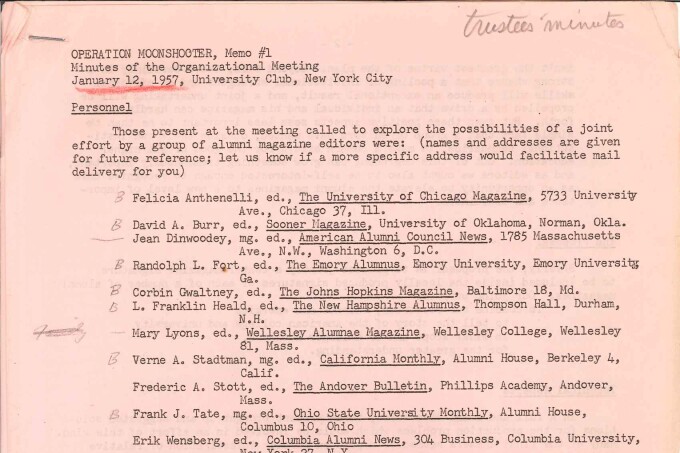
Today Education Week is recognized as the premier source of news, information, and analysis on K-12 education. But our origins are in the Sputnik era, when anxiety over the United States’ ability to withstand a concerted challenge to its technological pre-eminence touched off a wave of initiatives to improve the nation’s schools and colleges. In 1957, a bold experiment by 15 editors of leading university alumni magazines to speak with one voice to their readers as higher education sought to respond to the deep national concerns of that time. And this is where our story begins:
1957
The Soviet Union’s 1957 launch of the first manmade satellite to orbit the earth riveted attention on space and inspired the editors to call their collaborative research and writing project the “Moonshooter.” With a $12,000 grant from the Carnegie Corporation of New York, they produced a report the next year formally titled American Higher Education: 1958. Eventually, 150 colleges signed up for the 32-page report, which reached nearly 1 million college-educated Americans.
The success of that first venture led to the group’s incorporation as Editorial Projects in Education, a nonprofit 501(c)(3) organization, and the production of further reports and publications oriented to higher education. The most notable of those endeavors was The Chronicle of Higher Education. Launched in November 1966, on the eve of an extraordinarily turbulent period for America’s university campuses, The Chronicle was soon recognized as an unparalleled observer of the higher education scene.
The success of that first venture led to the group’s incorporation as Editorial Projects in Education, a nonprofit 501(c)(3) organization, and the production of further reports and publications oriented to higher education. The most notable of those endeavors was The Chronicle of Higher Education. Launched in November 1966, on the eve of an extraordinarily turbulent period for America’s university campuses, The Chronicle was soon recognized as an unparalleled observer of the higher education scene.

1978
In 1978, EPE sold The Chronicle to its editors—a decision that set the stage for a fundamental shift in direction by EPE to pre-K-12 education. Inspired by the example of The Chronicle, EPE determined that the precollegiate field likewise needed independent, first-rate journalistic coverage of national scope.

1981
Education Week was first published by EPE in September 1981 with just 18 employees and the support again of the Carnegie Corporation as well as other philanthropies.

1983
Just as the launch of The Chronicle had occurred on the cusp of an epochal period for higher education, the debut of the “chronicle of precollegiate education” came as the first stirrings of a remarkable age of ferment in elementary and secondary policy were being felt. And even as Education Week’s early issues were airing the still-new Reagan administration’s plans to curtail the federal role in education, the field’s upstart “newspaper of record” was pointing to new anxieties about the state of the nation’s schools that echoed those of EPE’s earliest days. Those concerns, emerging against a backdrop of global competition and economic dislocation, gained rhetorical force and political momentum with the 1983 federal report A Nation at Risk.

1996
Launch of edweek.org ushered EPE into the Digital Age and created a platform for the evolution of its Education Week flagship publication into an integrated print-digital news organization that provides distinctive staff-written original reporting, a forum for a lively but civil exchange of opinion on education issues, an unequaled online archive of 30-plus years of education coverage, high-quality content from news and information partners, interactive databases, and a host of video, multimedia, and other features that clarify complex points of policy and bring the stories of American schools, educators, students, and parents to life

1998
The company moves to Bethesda, Md., just outside Washington DC.

2002-2015
The ensuing waves of K-12 improvement measures known simply as “the reform movement” helped establish, in turn, Education Week’s role as the most trusted source of news and analysis on one of the biggest continuing stories in American society. That role took on fresh importance as Education Week tracked the far-reaching No Child Left Behind Act, signed into law in 2002, and now the implementation of its 2015 successor, the Every Student Succeeds Act.

2010
Education Week introduces a new series of special reports testifying to the time-tested value of print. At the same time, edweek.org employs a variety of digital tools to allow readers of a special report to delve deeper into its findings or explore the topic through online storytelling. Included in Education Week’s lineup of print editions are three high-profile annual reports—Quality Counts, Technology Counts, and Leaders To Learn From—and a mix of popular reports on such subjects as literacy instruction, personalized learning, student assessment, school principals, and teacher professional development.

2015
EPE launched EdWeek Market Brief, its first premium, membership-based information service. The online-only EdWeek Market Brief provides original data and actionable intelligence and analysis that aim to bridge the knowledge gap between pre-K-12-serving companies and the needs of schools and districts.

2020
Education Week celebrates a bold new look on edweek.org, realigning mission with brand. 2020 finds us with over 90 employees, an annual budget of $18 million and powerful offerings from Education Week, EdWeek Top School Jobs, EdWeek Market Brief. We continue to serve as the leading authority in education and are the comprehensive cornerstone for educators, policymakers, and business leaders alike. Join us as we look to the future and continue To Inspire and Empower.
Our People
Education Week’s reporters, editors, researchers, and leaders have vast expertise in the field. Find out who we are.
Learn More
Our Story
Education Week has been serving K-12 educators since 1981. Learn more about our history.
Learn More
Our Organization
We're the foundation, the fuel, and the force behind positive change in education. Find out how we're advancing the field.
Learn More
Advertise
Learn from a Marketing Solutions Executive on how to align with Education Week's powerful brand in an authentic way.
Learn More
Corporate Subscriptions
Stay informed about the K–12 landscape. EdWeek Pro Access gives your team shared access to Education Week’s trusted reporting, data, and analysis to inform strategy.
Learn More
Work With Us
Has what you've read excited you? Learn about how to ignite your career and join a world-class team of passionate professionals.
Learn More
