Artificial Intelligence

Beyond ChatGPT: The Other AI Tools Teachers Are Using

By Lauraine Langreo — August 15, 2023 4 min read
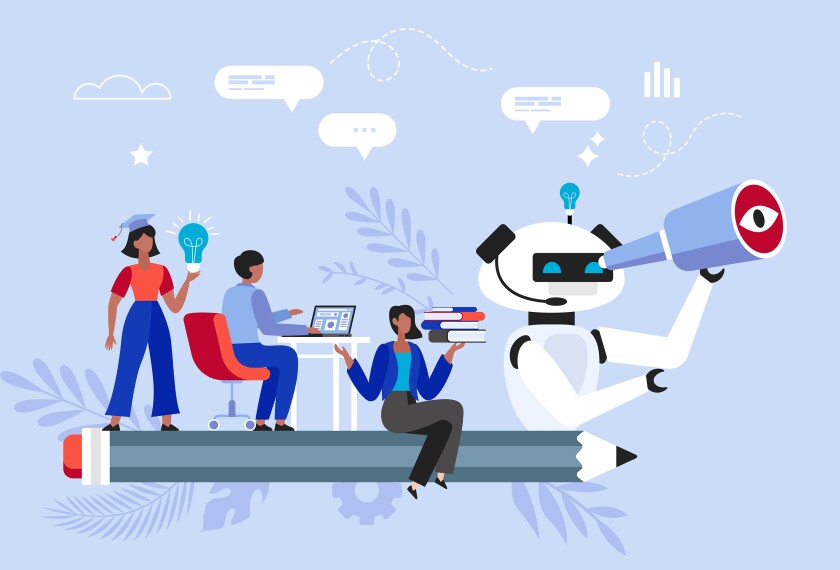
Illustration of a large pencil with three students on it using AI technology for studying and learning. There is a large robot at the front of the pencil using a telescope to look into the future.
  • Save to favorites
  • Print

Many educators have tried out ChatGPT, an artificial intelligence-powered tool that can instantly generate a response to seemingly any prompt, and they say it—and other similar tools—have helped them improve their work.

They’ve used generative AI tools to plan lessons, help struggling students with their assignments, streamline feedback on student work, and more.

Artificial intelligence technologies replicate human-like intelligence by training machines and computer systems to do tasks that simulate some of what the human brain can do. It relies on systems that can learn, usually by analyzing vast quantities of data and searching out new patterns and relationships. These systems can improve over time as they take in more information.

Of course, there are potential downsides to the new technology. It can produce inaccurate or biased responses based on faulty data it draws from, and it has the potential to cause huge data privacy problems. Experts have cautioned that when using these tools, it’s important to know how they were trained and what datasets were used. It’s also important to be skeptical about any information these tools provide and to double-check it with a trusted source.

ChatGPT, created by research laboratory OpenAI, is one of the most popular generative AI tools, being the first on the scene. Since its release last year, many more like it have cropped up. Below is are other generative AI tools teachers are using to help them with their work:

Google Bard and Microsoft Bing Chat

Bard and Bing Chat are, respectively, Google’s and Microsoft’s competitors to ChatGPT. Bard and Bing Chat function similarly to ChatGPT: They aim to give human-like answers to questions. They’re free and easy to use. They can write lesson plans and emails and provide feedback on assignments. But there are some differences.

For instance, the free version of ChatGPT was only trained on data available up to 2021, while Bard and Bing Chat can give more up-to-date information. Bing Chat runs on the premium version of ChatGPT, which has been trained on a wider range of information and is more advanced than the free version, while Bard uses a different model. Bing Chat also often cites where it got its answers, while Bard and ChatGPT do not.

Like ChatGPT, these chatbots are prone to making up information or producing biased responses. When using these tools, it’s best to always double-check the facts with other sources.

See Also

Teacher bot concept emerging from a laptop with a word bubble that reads "Hi"
iStock/Getty Images Plus

Hello History, Character AI, and other persona chatbots

Hello History, Character.AI, and other persona chatbots allow users to have real-time conversations with bots purporting to be historical figures, world leaders, and even fictional characters. The tools are trained on data available online and are supposed to mimic the speaking style and tone of their characters. These tools could be helpful for students to learn more about historical figures or fictional characters, but they are usually powered by the same technology behind ChatGPT, meaning that they can provide inaccurate information. For example, when Education Week’s Alyson Klein asked an Obama chatbot about his education record, it got a lot wrong.

DALL-E, Midjourney, and other art generators

Midjourney, OpenAI’s DALL-E, Adobe Firefly, and other similar tools can generate realistic and detailed images from textual descriptions. Students and teachers could use these tools to generate artwork to use in their assignments or presentations. But there are ethical concerns. Artists have filed lawsuits claiming that these companies trained AI tools on their artworks without consent. And experts say, while it’s good for brainstorming, it’s always better to ask students to create art without the use of these AI tools, so they can learn to be independent of these tools.

Education Copilot and other “teacher assistants”

Many education-focused AI assistants have cropped up, as well. Here are some examples: Education Copilot, Teacherbot, and Eduaide.AI. They all do tasks that ChatGPT can do for educators. They can generate lesson plans, handouts, writing prompts, project outlines, student reviews, and more. It’s unclear whether these tools are powered by the free or the premium version of ChatGPT, but many come with a cost, so educators tend to use ChatGPT instead.

See Also

Photo collage of teacher working at desk with laptop computer.
F. Sheehan for Education Week / Getty

AI assistants in existing ed-tech tools

Many ed-tech companies that are fixtures in the K-12 world have also added AI features to their products. EdPuzzle, an online video editing and formative assessment tool that lets teachers cut, crop, and organize videos, has added an AI assistant that can automatically generate questions that teachers can add to their video assignments. It can also grade students’ answers based on teachers’ ideal answers. Kahoot, a game-based learning platform, has also added a feature that can automatically generate questions based on any topic a teacher chooses. Canva, a free graphic design platform that has an educational version, added “Magic Write” and “Magic Design” features that generate presentations and documents based on any prompt.

Related Tags:

A version of this article appeared in the September 20, 2023 edition of Education Week as Beyond ChatGPT: The Other AI Tools Teachers Are Using

Events

This content is provided by our sponsor. It is not written by and does not necessarily reflect the views of Education Week's editorial staff.
Sponsor
School Climate & Safety Webinar
There But Not Present: Rethinking Student Engagement
Learn how to recognize the early signs of disengagement and what the behavioral science reveals about which interventions actually work.
Content provided by Frontline Education
Teacher Preparation Webinar What Teacher Education Should Look Like in the Age of AI
Explore the current trends around the use of AI in teacher preparation and continuing education with data from the EdWeek Research Center.
English Learners Webinar How Can School Districts Better Support English Learners With Disabilities?
Join this webinar to hear recent findings from the EdWeek Research Center and discover practical strategies for improvement.

EdWeek Top School Jobs

Teacher Jobs
Search over ten thousand teaching jobs nationwide — elementary, middle, high school and more.
View Jobs
Principal Jobs
Find hundreds of jobs for principals, assistant principals, and other school leadership roles.
View Jobs
Administrator Jobs
Over a thousand district-level jobs: superintendents, directors, more.
View Jobs
Support Staff Jobs
Search thousands of jobs, from paraprofessionals to counselors and more.
View Jobs

Read Next

Artificial Intelligence A Reckoning on Social Media Addiction Came Late for Kids. Will AI Safety Be Different?
Efforts to make social media safer offer lessons for those looking to protect children using AI.
5 min read
Kristin Bride, right, mother of 16-year-old Carson Bride, who died by suicide after being cyber-bullied on an anonymous app on Snapchat, is joined by Amy Neville, left, mother of 14-year-old Alexander Neville, who died from fentanyl poisoning after being deceived by a drug dealer operating on Snapchat, during a Social Media Victims Remembrance Day memorial on Capitol Hill, June 23, 2026, in Washington.
Rod Lamkey, Jr./AP
Artificial Intelligence Opinion Think Your Students Know More About AI Than You Do? Read This
Here are four things your students don’t understand about AI—and what you can do about it.
Sam Wineburg & Nadav Ziv
•
4 min read
102026 opinion Wineburg AI media literacy
Vanessa Solis/Education Week + Getty
Artificial Intelligence ChatGPT's 'Teen Mode' Is Unsafe for Students, Report Concludes
The chatbot failed to report unsafe interactions to parents in a timely manner, researchers found.
5 min read
Young man using a smartphone to ask an AI about exercise
Vanessa Solis/Education Week + Getty
Artificial Intelligence At OpenAI Forum, Discussion Focuses on Stronger Teen Safety Measures
Panelists put forward ideas on how to incentivize industry to develop responsible products.
4 min read
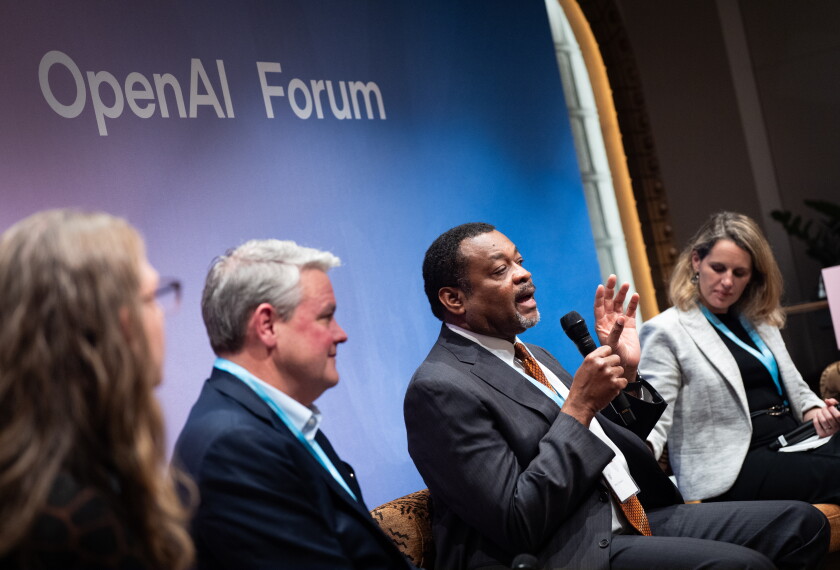
Washington, DC - October 5, 2026: Arthur C. Evans Jr., PhD, Chief Executive Officer of the American Psychological Association  speaks during the discussion. The OpenAI Forum hosted a panel on Responsible AI for Teens, how AI can support teens’ learning while promoting safe, healthy use. The program featured an OpenAI Forum panel with experts in learning, adolescent mental health, and family and online safety: Kate Ruane, Director of the Free Expression Project at the Center for Democracy & Technology, Chuck Melley, SVP of Policy, Advocacy and Communities at CodeAI, Arthur C. Evans Jr., PhD, Chief Executive Officer of the American Psychological Association and Mathilde Cerioli, Chief Scientist at everyoneAI. Chris Lehane, OpenAI’s Chief Global Affairs Officer, moderated the conversation and shared context on ChatGPT for Teens, a learning-first experience launched in August and designed to help teens think critically, deepen understanding, and use AI with confidence.
Arthur C. Evans, Jr., the CEO of the American Psychological Association, speaks on a panel at an Oct. 5, 2026, OpenAI forum on how to support responsible use of AI among teenagers.
Sarah Voisin for Education Week