
Artificial Intelligence

6 Things Teachers Do That AI Just Can’t

By Lauraine Langreo — September 07, 2023 2 min read
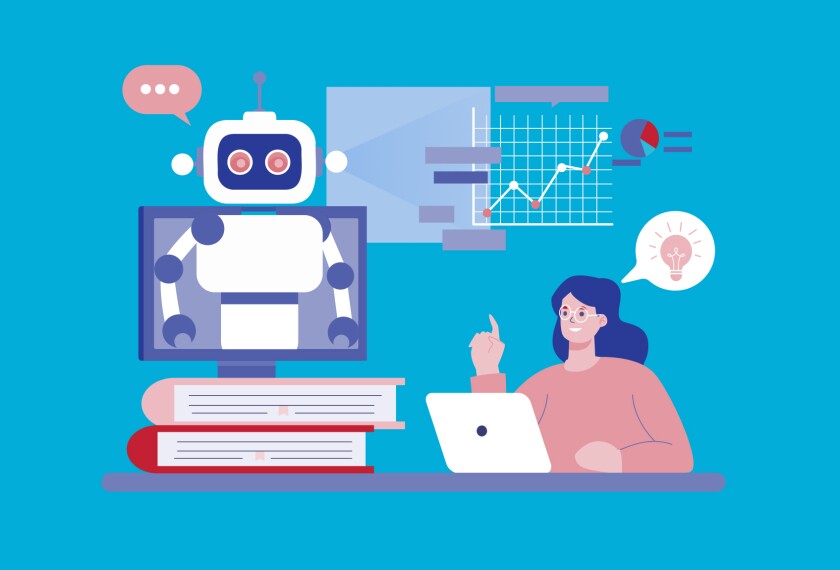
Illustration of woman using AI.
  • Save to favorites
  • Print

Tools powered by artificial intelligence have the potential to increase people’s productivity and make many tasks easier to do. In the K-12 world, educators are already using AI tools to plan lessons, create rubrics, provide feedback on student assignments, and respond to parent emails.

When asked what role AI-powered tools should play in teaching and learning, more than a quarter of educators (27 percent) said “creation of instructional materials,” 24 percent said “lesson planning for teachers,” 23 percent said “creation of assignments for students,” 12 percent said “grading students,” and 7 percent said “completing student paperwork,” according to an EdWeek Research Center survey of 1,301 district leaders, principals, and teachers conducted this summer.

Of course, there are downsides to this technology. For instance, AI tools can produce inaccurate or biased responses based on faulty data it draws from, and it has the potential to expose private and sensitive data. Many executives, researchers, and engineers have also raised red flags about AI’s potential to eliminate many jobs.

See Also

Illustration of stylized teacher student relationship with AI represented between them as layered screens.
Traci Daberko for Education Week

But teachers’ jobs are safe, experts say. While there are a handful of teacher tasks that generative AI tools can replicate, teachers also have so many other strengths and responsibilities that would be very unlikely to be replaced by those tools. In fact, even though AI “as a replacement for teachers” was one of the options in the EdWeek Research Center survey, no educator selected it as an answer.

Here are some teacher tasks that are unlikely to be taken over by AI tools, according to interviews and email responses from educators, AI researchers, and tech company CEOs:

Teaching critical thinking

   Problem solving often requires critical thinking, which involves the ability to analyze information, evaluate its relevance, and make informed decisions. Teachers guide students in developing these cognitive skills through thoughtful questioning, discussions, and activities. AI, while capable of processing vast amounts of data, lacks the depth of critical thinking and reasoning that humans possess.

— Dyane Smokorowski, digital literacy coordinator for the Wichita school district in Kansas

   A teacher is vital to the use of AI because they're going to be the gatekeepers. They're going to be the ones that validate the information and make sure that the AI isn't just sugarcoating things or putting things in the wrong category or whatever AI might do.

— Cherie Shields, high school English teacher in the Oregon Trail school district in Sandy, Ore.

Building relationships with students

   [AI is] not a human. It doesn't have relationships. It doesn't have history. It's not part of a culture. It doesn't have an understanding of students' individual needs. It can't be expected to inspire students, in terms of directions and future thinking. It doesn't understand social-emotional learning and mental health issues. It doesn't understand the family context of students. There's very many things that teachers remain critical for and always will remain critical for.

— Glenn Kleiman, senior adviser at the Stanford Graduate School of Education

   AI is unable to replicate the personal connections teachers build with their students. The emotional support and mentorship teachers provide are irreplaceable. Additionally, excellent teachers know their students well both as learners and as people. The teacher’s role to tap into student passions, talents, and curiosities to design dynamic learning experiences requires a human touch. Yes, a teacher can ask AI to help design a learning experience connected with a particular student’s passion such as soccer, anime, or computer science, but it takes the teacher to make that connection.

— Smokorowski

Motivating students

   The human touch is a huge part of motivation to learn, especially in K-12 students. Computers just can't match the kind of empathy that teachers have for their students.

— Tom Mitchell, professor and researcher in machine learning and artificial intelligence at Carnegie Mellon University

   Teachers play an extremely important role in supporting students' motivation to learn and, more generally, in helping them develop their own sense of identity as a learner, as citizen, as a future worker, and as a person. Teachers help students both through their direct interactions but also as role models. These elements of teaching and being a teacher will not be replaced by AI tools because the necessary skills and dispositions come from a lifetime of experience and involve interpersonal interactions.

— Ken Koedinger, professor of human-computer interaction and psychology at Carnegie Mellon University

Creating a positive learning environment

   AI will not replace the core work of teachers that supports positive learning experiences: inspiring and motivating students while helping them discover and explore their passions through: building of relationships with students and families; demonstrating empathy and compassion; helping students make meaning of complexities and develop meaningful questions (essential in a world where AI is prevalent); making certain students are valued, know and use their gifts and talents; ensuring physical and emotional safety and well-being; [and] building partnerships with community organizations, industry partners.

— Tara Nattrass, managing director of innovation strategy at ISTE/ASCD

   No amount of generated content or automated assessment will replace the value of teachers for students. Teachers are the ones who create a welcoming learning environment for a community of learners with diverse backgrounds and needs. Teachers are the ones who foster collaboration which prepares students to go onto a career or college. Teachers are the ones who inspire their students to become the person who they can't yet see in themselves. The purpose of school for students is broader than lessons and assessments.

— Adam Geller, founder and CEO of Edthena, which provides AI-powered professional development

   Teaching empathy, compassion, and emotional intelligence is a deeply human task that requires understanding and adaptation to each student's needs.

— Smokorowski

Providing high-quality feedback on student performance

   AI often faces challenges in delivering high-quality feedback on student work that demonstrates a deep understanding of the subject. These difficulties arise from AI's limited ability to grasp the broader context, assess subjective elements, and recognize creativity and originality. Furthermore, AI struggles with providing high quality, interdisciplinary projects, intricate problem-solving tasks, and the nuances of emotional and social interactions. Although it does an excellent job in assisting teachers as they develop products and performance ideas, it would be unable to provide high quality feedback on a choir, dance, or marching band performance, a piece of student artwork, even a student created Minecraft World.

— Smokorowski

Attending to students’ basic needs

   Teachers often have an acute awareness of their students' well-being. They can recognize signs of hunger, distress, or when a student is having a bad day. This empathetic connection allows teachers to provide not only academic support but also emotional and sometimes even physical support. AI lacks the ability to genuinely understand and address these fundamental human needs, making teachers irreplaceable in providing holistic care for their students.

— Smokorowski

Related Tags:

Events

This content is provided by our sponsor. It is not written by and does not necessarily reflect the views of Education Week's editorial staff.
Sponsor
College & Workforce Readiness Webinar
From Student Trends to Counselor Action: Turning Insight Into Impact
Find out what is changing in how students approach planning for life after graduation and how schools can help.
Content provided by PowerSchool
This content is provided by our sponsor. It is not written by and does not necessarily reflect the views of Education Week's editorial staff.
Sponsor
School & District Management Webinar
McKinney-Vento Transportation Strategies: Managing Cost & Protecting Access
Explore McKinney-Vento transportation strategies to manage costs, respond quickly to changing needs, and protect student access.
Content provided by HopSkipDrive
This content is provided by our sponsor. It is not written by and does not necessarily reflect the views of Education Week's editorial staff.
Sponsor
Families & the Community Webinar
Celebrate Family Engagement Day With Strategies That Work
Join National PTA and AASA to explore practical systems-wide family engagement strategies in celebration of National Family Engagement Day.

EdWeek Top School Jobs

Teacher Jobs
Search over ten thousand teaching jobs nationwide — elementary, middle, high school and more.
View Jobs
Principal Jobs
Find hundreds of jobs for principals, assistant principals, and other school leadership roles.
View Jobs
Administrator Jobs
Over a thousand district-level jobs: superintendents, directors, more.
View Jobs
Support Staff Jobs
Search thousands of jobs, from paraprofessionals to counselors and more.
View Jobs

Read Next

Artificial Intelligence Anthropic Agrees to Protections for Teachers Who Use Claude
AI giant will allow districts more contract protections for privacy and safety.
2 min read
Pages from the Anthropic website and the company's logos are displayed on a computer screen in New York on Thursday, Feb. 26, 2026.
The Anthropic website and logos is displayed on a computer screen in New York on Feb. 26, 2026. The company agreed to safeguards on Claude for Teachers demanded by a teachers’ union.
Patrick Sison/AP
Artificial Intelligence Q&A Students Who Turn to AI for Emotional Support Report Worse Mental Health
Some student uses of AI are associated with worse mental health and well-being outcomes.
5 min read
Collage image of a teen in front of a computer with speech bubbles overlaying the screen.
Collage by Laura Baker/Education Week + Getty
Artificial Intelligence Is AI Good or Bad for Learning? The Answer Isn't So Simple
A review of emerging research found that some use cases are more promising than others—but almost all offered caveats.
6 min read
collage of a brain shape made from circuits under a light.
Collage by Laura Baker/Education Week + Getty
Artificial Intelligence Lawsuit Blames a School-Issued Chromebook for Student’s Mental Health Crisis
The Chromebook was used to get feedback from an AI chatbot about mental health concerns.
4 min read
Google signage during a content capture event in New York, US, on Monday, Aug. 10, 2026. Alphabet Inc.'s Google introduced its latest smartphone lineup, bringing subtle hardware and design improvements at a moment when Apple Inc. and Samsung Electronics Co. will both be promoting flashier foldable designs leading into the holiday quarter.
Google promotes its name during a technology event in New York City on Aug. 10, 2026. A new lawsuit claims a 13-year-old student used a Chromebook and Google's Gemini chatbot to generate problematic responses about her mental health.
Michael Nagle/Bloomberg via Getty Images
