
Teaching Profession

Three Tips to Help Mentors Work Better With Teachers

By Sarah D. Sparks — January 30, 2025 3 min read
Illustration of a diverse group of 7 professionals helping one another climb a succession of large bars with some using a ladder.
  • Save to favorites
  • Print

For a novice teacher, a great mentor can mean the difference between launching into a successful career and burning out in the first few years.

When teachers have effective mentors, they can improve student learning in their first year as much as those without mentors perform in their third year of teaching. But schools and districts often structure their mentoring programs in ways that can undermine these relationships, according to a new report by the nonprofit New Teacher Center, which works with school districts to develop and improve induction programs for novice teachers.

“A lot of people have moved away from this idea of a ‘buddy’ mentor to saying, we need someone who can really support our teachers with instructional focus, setting up optimal learning environments for students,” said Vera-Lisa Roberts, a program specialist with the center. “What we have found is having a full-time coach or mentor assigned to a teacher—able to meet with them on a regular basis to help them plan, observe instruction, provide feedback, analyze student learning, get to know their students—that has been the link that has helped a lot of teachers feel connected.”
See also

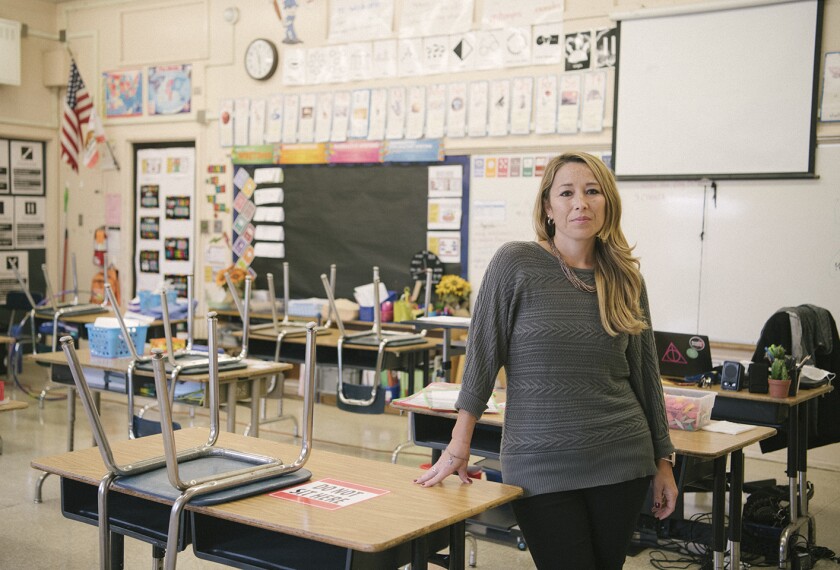
Misti Kemmer, a 4th grade teacher at Russell Elementary School in Los Angeles, had a negative experience being mentored as a new teacher, but is now a mentor herself.
Morgan Lieberman for Education Week

“Just like you want your students to feel emotionally, intellectually, and physically safe, how do we provide that same experience for our teachers?” Roberts said.

Roberts suggested three critical but often-overlooked practices for building effective teacher mentoring.

1. Pick the right people

Administrators should have a set process and clear criteria to choose mentors, the report said. Even those with content and classroom expertise also need relational skills: knowledge about how to collaborate, and the ability to address specific teacher needs.

For example, Hawaii offers specialized mentors for teachers hired under emergency credentials to fill special education shortages. These teachers often need help understanding how to manage paperwork associated with individualized education programs and working in co-teaching environments, a common arrangement in mainstream classrooms.

2. Define roles for mentoring

Mentors need clear roles, according to Tracy Laughlin, the New Teacher Center’s communications director. Without them, mentors often get tapped to revise curriculum, administer assessments, and other tasks.

“As mentors and coaches get assigned all these other duties as well, they spend less and less time doing that [mentoring] work,” Laughlin said.

One 2012 study suggested those teachers who mentored only part time, in addition to other instructional or administrative roles, had “less connection with the goals of the program, and may be likely to do their own thing with novices.”

It’s also important, Roberts said, for the teacher, mentor, and administrator to understand their separate responsibilities, “so that we’re all informed of those same goals and we’re working in support of everything, rather than [the teacher saying], ‘Here’s the principal giving a message. Now my mentor’s giving me this message, and I’m hearing two different things.’”

3. Dedicate the time

“One of the most common mistakes districts make is when they do not provide the sanctioned time for the mentor and the mentee teacher to have those one-on-one conversations,” Roberts said.

About three-quarters of the more than 1,000 districts nationwide which the New Teacher Center works with set and protect time for mentoring and teacher collaboration as part of the normal school schedule.

“New teachers need community. Whether it be through professional learning time, office hours, coffee time, but new teachers really need to come together with one another for that support,” Roberts said. “If not, you can feel a lot of isolation. You can feel that you’re the only one who is experiencing this, when we know that that’s not the case.”

Events

This content is provided by our sponsor. It is not written by and does not necessarily reflect the views of Education Week's editorial staff.
Sponsor
Teaching Profession Webinar
Evaluation Beyond the Checkbox: Turning Ratings Into Teacher Growth
Ratings alone don’t help teachers improve. Join us Nov. 10 to hear what happens after the evaluation: feedback, follow-up, and growth.
Content provided by Frontline Education
This content is provided by our sponsor. It is not written by and does not necessarily reflect the views of Education Week's editorial staff.
Sponsor
Assessment Webinar
The Assessment Trust Crisis: How to Measure Learning in the Age of AI
AI is reshaping learning. Is assessment keeping up? Join this webinar to explore how to measure student thinking, not just right answers.
Content provided by Instructure
This content is provided by our sponsor. It is not written by and does not necessarily reflect the views of Education Week's editorial staff.
Sponsor
College & Workforce Readiness Webinar
From Student Trends to Counselor Action: Turning Insight Into Impact
Find out what is changing in how students approach planning for life after graduation and how schools can help.
Content provided by PowerSchool

EdWeek Top School Jobs

Teacher Jobs
Search over ten thousand teaching jobs nationwide — elementary, middle, high school and more.
View Jobs
Principal Jobs
Find hundreds of jobs for principals, assistant principals, and other school leadership roles.
View Jobs
Administrator Jobs
Over a thousand district-level jobs: superintendents, directors, more.
View Jobs
Support Staff Jobs
Search thousands of jobs, from paraprofessionals to counselors and more.
View Jobs

Read Next

Teaching Profession Q&A Why Young Students Make New Teachers Sick, and How to Protect Yourself
An infectious disease expert explains the risk of common viruses and best practices for prevention.
6 min read
102026 cold flu season new teachers 1460190325
Vanessa Solis/Education Week + Getty
Teaching Profession Managing Teacher Attendance: Tips for Education Leaders
A short guide can help you think through the complexities of teacher absenteeism.
1 min read
Image of teacher support
DigitalVision Vectors + Getty
Teaching Profession The Data on Teacher Absenteeism Can Be Misleading. Here's What to Know
Partly due to leave policies, a third of teachers miss 10+ days of school per year. Can districts curb the absences?
6 min read
An elementary classroom is stocked with school supplies at BASIS Flagstaff on Thursday, Aug. 6, 2026, in Flagstaff, Arizona.
An elementary classroom at a public charter school on Aug. 6, 2026, in Flagstaff, Ariz. New data from the U.S. Department of Education finds that teacher absenteeism has risen.
Cheyanne Mumphrey/AP
Teaching Profession Opinion No, Self-Directed Learning Doesn't Make Teachers Obsolete
When students own their own learning, professional expertise becomes more important.
Tyler Thigpen & George Philhower
•
5 min read
Collage-style illustration of a young student standing on a dotted line path that zig-zags from the bottom of the frame to the top right. The student is wearing a backpack and pointing to a yellow circle on the end of the path at the top right. At the bottom of the frame a teacher's hand is open and facing upwards at the beginning of the dotted path. Smaller yellow dots are placed along the path, near the teacher's hand and where the student is standing.
Illustration by Emily Wright for Education Week + Getty
